
In a globalized world “no country is an island,” to paraphrase John Donne. A colorful map produced by the U.S. government agency NOAA shows that energy wav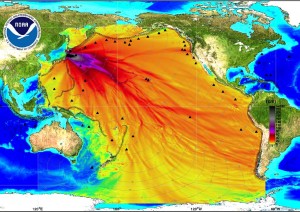 es from the earthquake that devastated parts of Japan on March 11, 2011 reached all the way across the Pacific Ocean to the shores of South and North America. Soon year-old debris will be washing up on the beaches of California.
On March 5 Janet and I leave for Japan, where I will speak at several events commemorating the earthquake and tsunami. We’ve all seen videos that seem taken from a special-effects horror movie: of ships, houses, and trucks tossed down the streets like toys, of a modern airport suddenly submerged under water, of a nuclear reactor tower exploding in a thick black cloud.
While preparing for this trip I’ve been reminded again of the magnitude of the 2011 disaster in which 20,000 people died. The wall of water reached a maximum height of 132 feet—as tall as a twelve-story building!—destroying 270,000 buildings in its path and forcing hundreds of thousands of people into temporary housing. A year later, many still live in those temporary structures, and it will cost at least $200 billion to replace the damaged buildings. When I think of the enormous effort involved in addressing the damage caused by Hurricane Katrina, I can hardly fathom the challenges facing Japan.
We will spend several days in the areas directly affected, which involves a journey of four hours by bullet train and car from Tokyo. Christians comprise only 1 percent of Japan’s population, and these meetings will be small; one church now meets in a printing company, its sanctuary having been washed away by the tsunami. Mission agencies and local Christians responded quickly to the human tragedy, and the government has gratefully used surviving churches as distribution centers for food and supplies.
I have spoken in some tough places, such as Virginia Tech after the shootings and Mumbai the night after the terrorist attacks. Never have I faced a tragedy so massive in scale. I’ve learned, though, that for the people involved, scale doesn’t matter so much. Pain zooms in very personally: a child swept away from a kindergarten playground, pets and livestock abandoned as their owners had to flee, a family business destroyed in an instant, a teenager terrified by the aftershocks that hit weekly, everyone frightened by the invisible threat of radiation. For a theme my hosts chose the title of my last book, What Good Is God?—an appropriate question for people who have endured such an event.
We have much to learn from Japanese resilience. Two of my uncles served in U.S. Army occupation forces just after World War II. Allied bombs had left some Japanese cities with hardly a building still standing. My uncle told me of soldiers who tossed away candy wrappers only to see hungry Japanese children scramble to lick the wrapping paper. Due to the lack of oil, public buses resorted to using charcoal or wood as fuel, with a man perched on the roof to shovel chunks into a steel-barreled tank for burning. Yet in fifty years that devastated economy rose from the ashes to become the second-largest in the world. A recent poll shows that most Japanese believe the country will emerge stronger not weaker after the earthquake.
The Japanese responded to this massive tragedy with amazing calm and patience. I remember the long lines of people waiting to be served rice at the distribution centers and the hundreds sleeping without complaint on mats in gymnasiums. Residents voluntarily turned in at least $75 million of money and valuables found in safes and drawers as they cleaned up debris. I cannot help comparing their responses to the chaos and shrillness that followed Hurricane Katrina.
I am attaching a video produced in the earthquake area as a thank-you to the rest of the world: http://www.youtube.com/watch?v=SS-sWdAQsYg. I confess that I have limited tolerance for watching Youtube videos, which usually hold my attention for about eight seconds. This one is eight minutes long and I’ve watched it several times. If you haven’t seen it, you should.
After our visit to the earthquake area, we will return to Tokyo for several meetings, including a National Prayer Dinner involving members of the Japanese Diet, or Parliament. I look again at the colorful map created by NOAA, and am reminded of a principle I learned from Dr. Paul Brand: a healthy body is one that feels the pain of the weakest part. On March 11, I hope that prayers of support and care from the U.S. and other countries reverse the energy flow depicted in the map.
The Apostle Paul gave us a clear formula for how we should respond to those in suffering and need: “Praise be to the God and Father of our Lord Jesus Christ, the Father of compassion and the God of all comfort, who comforts us in all our troubles, so that we can comfort those in any trouble with the comfort we ourselves have received from God. For just as the sufferings of Christ flow over into our lives, so also through Christ our comfort overflows.” May we channel that comfort to the people of Japan, whose suffering has not ended.


Bless you mate. Your books have affected me down here in New Zealand, to the betterment of my own life.
Philip, thank you for posting this “arigato” from Japan. I was brought to tears as I watched. God is gracious. While many were lost, many more were saved. I pray that you will be a blessing to those you meet and that they will in turn bless your life.
Last week I read again Soul Survivor and this week I’m re-reading What’s so Amazing About Grace? Every time I read these books, I’m brought to me knees. Your experience growing up in the south was much like mine. By the grace of God I held on to my faith and learned that people will make God into their own image. It is up to me to see Him as He is and to believe in His marvelous grace toward all who will receive Him and sometimes even to those who do not yet know Him. Thank you for every reminder of God’s grace.
I can’t thank you enough for your ministry in writing and spreading God’s words to the world. I just finished What Good is God and have all the rest of your books. God has given you via His Spirit, much wisdom and understanding to help the rest of us on our daily walk with Christ. I am 75 and have survived two severe bouts of cancer. I can still praise Him and because I am still here to do so, will praise Him until the end of my days. He is just and faithful all the time. I am a walking miracle.
Thank you for your ministry to us.
It is called the Shimizu ?????in Japanese. Most irnefgreos don’t know about it but all Japanese do.I am going to share the secret with you.As you know, it is very difficult to gain entry into Japan’s top university, Tokyo University. So hard in fact that many people study several years at expensive cram schools after high school to pass the entrance exam. There have been well known instances of students ending their lives after several failed attempts at entry. Apparently back in the 60 s the last question on the last page on the last day of testing contained a question that stumped many a Japanese genius. The question was; how many liars are in a room when both people are being kind to each other ? Was this a trick question? A test of ethics? Is zero a number? Honne and tatemae relevant? These questions and many others went through the head of the now famous 19 year old Shimuzu san as he sat in the hot examination room back in the late summer of 1967. Japanese children to this day are taught to do the Shimuzu so as to not forget that young student named Shimizu and his failure to answer that question correctly and how he went on to end his life. Sad and alone. The next time you are asked to pose for a camera please do not forget young Mr. Shimizu. Everyone knows zero isn’t a number.
Good day,i’m a nigerian and i just got started with your book on WHERE IS GOD WHEN IT HURTS? And as someone who has had quite a few disappointments,i am usually tempted to just give up on God and throw in the towel.I have infact attempted an atheistic lifestyle but your book has truly helped me in having a firm faith in God.May God bless you richly,once again Thanks.