
My life divides into geographical thirds—one-third in Atlanta, one-third in Chicago, and one-third in Colorado—and each has presented a different perspective on winter.
In the Atlanta of my childhood enough snow would fall to accumulate on the ground maybe once every two or three years. These were magical days of cancelled school, snow forts and snowball fights, and snowmen decorated with branches for arms, radishes for eyes, and a carrot for a nose. The magic was ephemeral, however: a week later a warm spell might lure forsythia bushes into a false spring, coaxing out yellow blossoms vulnerable to the next frost. More commonly we faced winter ice storms that brought down trees and power lines and treacherously coated roads (you may have seen a video clip of the guy ice-skating down Peachtree Street this winter).
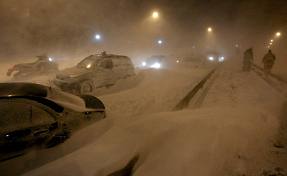
Now, Chicagoans, they knew how to handle winter! Until this year’s storm the city had not cancelled school classes for a dozen years. Footage of the surreal sight of a thousand cars abandoned on Lake Shore Drive brought back memories of days when I used to jog along that major artery. I had determined never to let weather deter me from outdoor exercise, though I did wear a painter’s mask over my mouth whenever the thermometer dipped below zero. Once I was running on the narrow breakwater along Chicago’s lakefront when suddenly I found my legs pumping against pure air, not concrete. Ice from a rogue wave had coated the top step and I had slipped off into empty space. I felt like Wile E. Coyote chasing the Road Runner when he looks down and realizes he has just run off a cliff.
Chicagoans love to grouse about the cold but I’m convinced they’re bluffing. Secretly, they love it. I noticed, for example, that people seemed most friendly on days most frigid. At bus stops we actually talked to each other, albeit mumbling through breath-frosted scarves. Conversation rarely strayed from one topic—the cold—yet at least we were talking. “It was so cold that my wine rack froze last night, splattering purple all over the walls of my dining room.” “Tried to get my dog outside this morning. She took one sniff and headed for the radiator.” “I heard the difference between forty below and thirty below is that your spit freezes before it hits the ground. At sixty below your eyeballs start to freeze.”
A good blizzard rearranges priorities. A million people may be marching in downtown Cairo and war grinds on in Afghanistan but local newscasters will swap stories about the cold for five minutes before they acknowledge such world events. For now, at least, our real opponent is outside and we humans hunker down and huddle together to survive.
A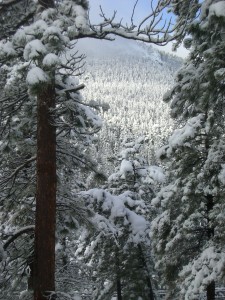 winter storm also rearranges the landscape. Ice floes pile up arctically against Lake Michigan’s shore, parked cars become snow moguls, and every dead tree transforms into an exquisite work of art. In a city, though, the beauty lasts a mere day or two before snow becomes an ugly pile of brown slush. Not until I moved to Colorado did I experience the lasting beauty of winter. Snow stays white for months in the Rocky Mountains. It outlines craggy peaks, sugar-coats evergreen trees, and smothers dead grass under a blanket of glistening white. Thanks to snow I can follow animal tracks back to the homes of the raccoons, skunks, and foxes who have been eating the birdseed that falls beneath the feeder.
Coloradans know what to do with winter—indeed, our economy depends on it. I ice-skate on a lake near my home, cross-country ski or snowshoe on trails that begin in my backyard, and downhill ski in some of the world’s finest champagne powder. Meteorologists monitor the snow pack like a patient in Intensive Care because most of the moisture that feeds our streams and rivers falls in frozen, not liquid, form. (There are downsides to winter here, of course: when the thermometer hit 23 below zero last week one of our pipes froze.)
Just as Chicagoans will be talking about the winter of 2011 for years to come, Coloradans swap stories about the blizzard of 2003. Where I live, seven feet of snow fell in two days that March. My house lost electricity for an entire week, which means we lost central heating and our well. Fortunately, we had a propane stove on which to melt snow for water and a wood-burning fireplace that could “warm” the house to 50 degrees. It took me several hours just to shovel a path to the wood pile. No snow plows or bulldozers could get through until we chain-sawed the trees that had fallen across our road and driveway.
With my computer useless, I had thoughts of cozying up to a fireplace and reading books for several days, only to discover that it’s hard to read when you’re shivering and, more to the point, snowdrifts had blocked out most outside light and covered all skylights. After the last flakes had settled, I buckled on snowshoes and laboriously hiked up the hill behind my house. With each step the snowshoes sank through powder to a depth of about three feet and I could only move forward by lifting a foot as high as I could and then lunging. When I reached the top of the hill I saw a glorious sight worthy of the first day of creation: a gleaming white landscape of snow-covered hills leading to two majestic 14,000-foot mountains to the west. With no traffic on nearby roads, silence was thick as the snow. Laden, the trees appeared to bow in respect to a higher power.
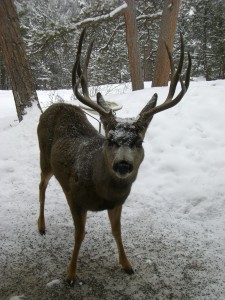 Without warning a sharp sound like a rifle shot interrupted my reverie and instinctively I ducked. Another report followed, then another. As I watched, branches of Ponderosa pine trees thicker than my waist gave way to the weight of snow and cracked, crashing to the ground with a mighty whoosh! More than 200 trees fell to the ground that day in sight of our home. Below me, two mule deer plunged through the snow in a panic, leaping high and falling exhausted, panting, to gain strength for another leap.
As it happened, the Iraq War began the day of the big blizzard. Sparingly, so as not to drain batteries, we would turn on a portable radio and listen to faraway news of the “shock and awe” bombardment of Baghdad in the desert. No one could imagine then what a quagmire that war would lead us into and how it would change the globe. Its repercussions continue to this day as crowds swarm in the Middle East, some of them chanting for freedom, some chanting anti-American slogans.
We think we run the world, we humans. We think we manage history and determine its outcomes. One of winter’s gifts, all too brief, is a reminder of just how little lies under our control. Winter, above all, offers a reminder of creaturehood. Once more we see ourselves as tiny, huddling creatures dependent on each other and on the God who created the awesome universe. “God’s voice thunders in marvelous ways,” said Elihu to Job. “He says to the snow, ‘Fall on the earth,’ and to the rain shower, ‘Be a mighty downpour.’ So that all men he has made may know his work, he stops every man from his labor.”
Last week a blizzard covered most of the continent, grounding seven thousand planes and turning major cities into Nordic ski parks. As reported on CNN it seemed a disaster. I wonder, though. Childhood laughter and adult community, beauty on grand scale, a potent lesson in humility—for these rare gifts, shouldn’t winter prompt more gratitude than grousing?


Hi Philip,
I know this is probably not the most professional way to get in touch with you through a comment on your blog, but I have read most of your books and I take much delight in them because of the knowledge and wisdom I gain. You see, my profession needs your books. I am a group therapist in an adult psychiatric unit. I see suffering every day I work. I would really enjoy talking with you more about this through email so I can gain even more of your knowledge in this area. I understand though if you are busy. Thank you for your writings and for letting the Spirit guide you. It has impacted me greatly.
I like your “glass half full” way of looking at winter!
BTW — the CAPTHCHA code bar in the comments field is easy to use. It shouldn’t hinder anyone from leaving a comment… and it certainly cuts down on SPAM.
It is also changeable by pressing the lower button if the letters and numbers aren’t easy enough to read.
Mr. Yancey,
I really enjoy reading your posts, and, as a Chicagoan, this one was very interesting. I’m in high school and my perspective on the ’11 blizzard was mostly “school closed for two days.” Your post made me think of the community hardships bring in a different light. As my twin always says, “there is something about those things that bring people together, whatever they may be, that I love.”
On a broader note, thank you for all that you write and do. As a sixteen year old, I often feel that books written for my age these days are so limited and secular. I find that your books help me to think, ask and seek in a way that few books do. Your books, and your simple, honest approach to difficult issues shake me from my limited perspective, show me a world that is so much more broken and so much more beautiful than I can imagine, and gently place me at the feet of a God more confusing and more compelling than anything I’ve imagined. I also like your books for the same reason you may get some angry mail–they are honest, not sugarcoated, and say things as they are. Yet you also say things about how they could be. I appreciate that. As the daughter of a theology professor, and a less conservative one, I often find that I am irritated by the faith that never questions. Your books help me find a balance between doubts and trust.
I also relate to you in a literary way–writing has been my way of asking questions for years, although more in poetry form than books. I find that there is something about the power and ambiguity of words and poetry that enable me to express myself like no other way. My dream is to write as a career.
As a sidenote, is there any way I can email you and get a response? I have always wanted to have a chance to talk to you about christianity.
Hi PY
I’ve been reading many books from you, I have enjoyed, and Gods used them to talking to me. Thank you, we need more people thinking in the same way. The grace and the love. Do you have written something about de immigration issue? Do you have articles or book about this topic? I can’t waiting to know how a person like you present this issue on biblical truths. Bblessings
Mr yancey,
Why is that every time i get mad at God, he has something wiser to tell me?
Why doesn’t he only give up on me?
This morning i was taking my two kids to school , it was raining and very cold. Not snowing. In leave in Italy. I was looking for a cab, noway to find one. One umbrella, three creatures, result, we all got wet ,with not appropriate shoes and clothes. At one point , i see a cab….but , i also see a couple running to get the cab. So, i kindly ask them: please i have two kids to take to school, we are all wet, can i get it please? He says: No, i was first.
I tried to tell him that i was there waiting before him, i had two kids wet ,late for school . No, he says onemore time.
I was with two kids , wet ,late for school, shouldn’t he had given me the cab?
I got mad. Very mad. My daughter complaining that her foot was wet, i decided to go back home , no school today…
Maybe this was just a little drop, in a ocean of difficulties i am going trough….
Maybe i am always thinking that God’s favour have to follow me….
Maybe, i had to show God’ s love to that men who ignored the fact that i had two kids wet, willing to go to school?
Maybe the problem is that i put God everywhere ,everything i do? But he thought me this way, i can’t live differently….
But, maybe he was only trying to show me one more time, how weak i am, and how such a small thing such as this , can stop me from doing what i want, and going where i thought i should be going….
It reminders me one more time of whom is in control of my life.
It would be a Miracle for me, if you Mr. Yancey ,would answer this. Since ” amazing grace”, my life has been changed by your writings…..
Thanks
maria