
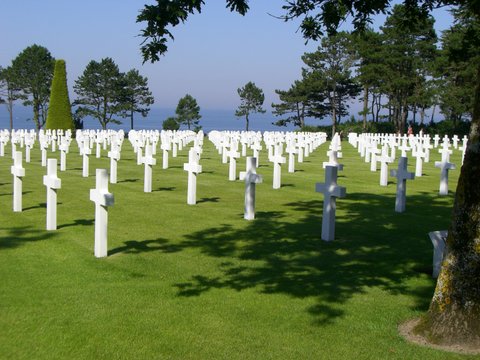
 On a visit to France last week I visited some of the sites of D-Day. More American soldiers died on the first day of that massive invasion than have died in eleven years of war in Afghanistan. Twenty-seven war cemeteries in the region hold the graves of 110,000 dead from both sides, for June 6, 1944, marked only the beginning of a vicious month-long battle for Normandy.
Today the battlefields seem like overgrown golf courses, with open expanses of grass and wild flowers interrupted by shallow depressions—not sand traps, though, but bomb craters. Some of the thousands of concrete German bunkers survived the bombers’ aerial assault, and crouched inside them you can imagine the scene as a teenage soldier rubbed his eyes the morning of June 6, 1944 and looked out at a massive flotilla of 6,000 ships disgorging troops and tanks on the beaches of Normandy.
Some of the soldiers had sloshed around in a historic English Channel storm for 72 hours before landing, jammed together shoulder-to-shoulder on flimsy landing craft and puking their guts out. By the time they hit the beaches, said one general, “They would have taken on the entire German army single-handed rather than get back on one of those ships.” In a scene captured in the movie Saving Private Ryan, they jumped from their boats to fall on a beach littered with war debris and the dead bodies of their comrades. Smoke bombs all but obscured the view, perhaps a mercy as the Germans trained artillery, machine guns, and grenade launchers on the exposed strip of sand.
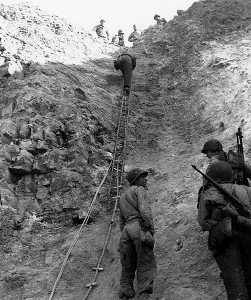 A stark granite column rises atop one of the most picturesque sites of Normandy, a sheer hundred-foot cliff that Army Rangers climbed in the face of withering fire in order to seize German artillery. As the Rangers attempted to scale the cliff, some using ropes and some clawing their way up bare-handed, German snipers leaned over the edge and picked them off one by one. Of the 225 who began the assault, 90 survived to take the German positions—only to find that the artillery had been moved and replaced with decoys.
Following a friend’s advice, I visited not only the famous American cemetery, with its rows of white marble crosses and Jewish stars marking the graves of 9,387 American soldiers, but also one of the German cemeteries—less dramatic, more somber, holding the graves of some of the 77,000 Germans who lost their lives. Touring through Europe, you face constant reminders of the centuries of bloodshed: the Hundred Years’ War, the Second Hundred Years’ War, the Thirty Years’ War, the Wars of Religion, the Crusades, two World Wars, the Balkans’ Wars, the Norman Conquest, Napoleon’s wars. Restored forts and castles preserve the scenes, museums tell the stories, cemeteries mark the outcomes. Some, like World War II, are commemorated as “good” wars: brutal and destructive, yes, but necessary to restrain a greater evil. Others seem petty, absurd, ridiculous.
“When we have overcome absence with phone calls, winglessness with airplanes, summer heat with air-conditioning—when we have overcome all these and much more besides, then there will abide two things with which we must cope: the evil in our hearts and death.” Nicholas Wolterstorff wrote those words in his poignant tribute Lament for a Son. On the battlefields of Europe—and not just Europe— those two things converge.


Very moving Mr. Yancey. This make that stupid Chick-Fil-A thing and all the other petty stuff going on new seem most ridiculous. Keep up the good work.
And don’t think Satan parades these facts before our Lord constantly: “See? Do you really want to help these bloodthirsty vermin?”
Funnily enough I re-watched “Saving Private Ryan” last night on tv- I cannot recall a film that seemingly captured the stark reality of war so much or the moral dilemmas that go with it.
The issue of whether there is ever a “good war” is certainly a tough one.
Were you at Point du Hoc? That is where, if I’m not mistaken, President Reagan gave his speech honoring the Boys of Point du Hoc in June, 1984.
It doesn’t seem to matter what our political beliefs are, when it comes to WWII, we all seem to tear up when it comes to thinking about the sacrifice that our fathers and grandfathers made. It seems that we, as a country, had no choice but to get into that war. Hitler and his allies made it clear that their goal was total world domination. The Nazis were intent on creating a world with only those people that they deemed worthy. While the Holocaust was horrible, and reason enough to enter the war, it was becoming clear that the Nazis would not stop with genocide of one group of people only. There were many groups of people whom the Nazis were intent on destroying. Gypsies, the handicapped and disabled, homosexuals, among many others were victims of concentration camps. I am very proud of my father for being a part of that war.
Having said that, we must always guard our own hearts. As individuals, at some point in time, the Nazis were just like everyone of us. We are all human. We can be lead astray. If we are not careful, our hearts can become hardened, and we can harbor evil. We must always be on guard to allow the light of Jesus to guide us. What is it that He wants us to do or think. Mercy and compassion and love should always be our objectives.