

 Unlike most people, I do not feel much Dickensian nostalgia at Christmastime. The holiday fell just a few days after my father died early in my childhood, and all my memories of the season are darkened by the shadow of that sadness. For this reason, perhaps, I am rarely stirred by the sight of manger scenes and tinseled trees. Yet, more and more, Christmas has enlarged in meaning for me, primarily as an answer to my doubts, as evidence of the Creator who exults in life and beauty.
In Christmas, the material world and the invisible world come together. If you read the Bible alongside a Civilization 101 textbook, you will see how seldom that happens. The textbook dwells on the glories of ancient Egypt and the pyramids; the book of Exodus mentions the names of two Hebrew midwives but neglects to identify the pharaoh. The textbook honors the contributions from Greece and Rome; the Bible contains a few scant references, mostly negative, and treats great civilizations as mere background static for God’s work among the Jews.

Yet on Jesus the two books agree. And with each online calendar reminder, the flashing date implicitly acknowledges what the Gospels and the history books both affirm: whatever you may believe about it, the birth of Jesus was so important that it split history into two parts. Everything that has ever happened on this planet falls into a category of before Christ or after Christ.
In the cold, in the dark, among the wrinkled hills of Bethlehem, God who knows no before or after, entered time and space. One who knows no boundaries at all took them on: the shocking confines of a baby’s skin, the ominous restraints of mortality. “He is the image of the invisible God, the firstborn over all creation,” an apostle would later say; “He is before all things, and in him all things hold together.” (Col. 1:15, 17) But the few eyewitnesses on Christmas night saw none of that. They saw an infant struggling to work never-before-used lungs.
Why did Jesus come to earth? Theologians tend to answer that question from the human perspective: He came to show us what God is like, to show us what a human being should be like, to lay down his life as a sacrifice. I cannot help thinking, though, that Incarnation had meaning in other, cosmic ways.

God loves matter. You can read God’s signature everywhere: rocks that crack open to reveal delicate crystals, the clouds swirling around Venus, the fecundity of the oceans (home to 90 percent of all living things). Clearly, according to Genesis, the act of creation gave God pleasure.
Yet creation also introduced a gulf between God and humans, a gulf that can be sensed all through the Old Testament. Moses, David, Jeremiah, and others who boldly wrestled with the Almighty, flung this accusation to the heavens: “Lord, you don’t know what it’s like down here!” Job was most blunt: “Do you have eyes of flesh? Do you see as a mortal sees?” (Job 10: 4-5)
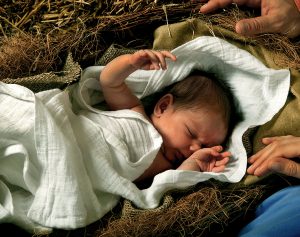
They had a point, a point God underscored with the decision to visit planet Earth. Choosing words that astonish, the author of Hebrews reflects on Jesus’ life as a time when he “learned obedience,” “was made perfect,” and became a “sympathetic” high priest. There is only one way to learn sympathy, as signified by the Greek roots of the word sym pathos, “to feel or suffer with.”
Of the many reasons for Incarnation, surely one was to answer Job’s accusation. Do you have eyes of flesh? Yes, indeed.
I, a citizen of the visible world, know well the struggle involved in clinging to belief in another, invisible world. Christmas turns the tables and hints at the struggle involved when the Lord of both worlds descends to live by the rules of the one.
In Bethlehem, the two worlds came together, realigned; what Jesus went on to accomplish on planet Earth made it possible for God someday to resolve all disharmonies in both worlds. No wonder a choir of angels broke out in spontaneous song, disturbing not only a few shepherds but the entire universe.
Adapted from Finding God in Unexpected Places

Subscribe to Philip’s monthly blog:



“Christmas turns the tables and hints at the struggle involved when the Lord of both worlds descends to live by the rules of the one.”
This gave me goosebumps. Thank so much, as always, for writing sir Philip Yancy. Love from Pakistan. Merry Christmas!
Thankyou! You remain my favorite author as no one else I have read imbeds so much thought and wisdom into such honest expressions and images of God. And that is truly beautiful!
Hi Philip. Thank you for your message. I’ve been dwelling for a long time on the effect that a baby can have on us, in contrast to imposition of power play. That vulnerability speaks to our own, and I find that that’s the most compelling thing about the Christmas story. So here’s a poem called ‘Unprepared’.
We prepared for your coming,
with fireworks – a veritable
sky-show –
military brass bands befitting a
king and mighty warrior,
a podium festooned with
bunting,
and well rehearsed speeches.
But our fireworks were
reduced to a single star
and a flickering lamp
throwing up beastly shadows
on a stable wall,
and our fanfares drowned out by the cries of a young woman,
a child giving birth to a child,
bunting stripped away in preference for straw,
and dignitaries upstaged by a motley crew of sheep herders;
And our speeches?
Our fine, eloquent speeches reduced to “Oohs,” and “Aahs. “
And somewhere in our silly, soppy defencelessness
you made yourself at home.
Sr. Sandra Sears CSBC 2010
Very nice. I once heard the Incarnation described as “fireworks in reverse”: glorious light condensed into an ordinary paper package.
Thank you for your comments.
So much of even the best academic theological inquiry tries to answer, “What was the Incarnation for” , by pointing out the (genuine) benefits to the human race … “What’s in it for us?” I like that you inquire what might have been in Creation and the Incarnation that was for God’s own purposes including but in addition to our own salvation. There are, for example, clues in passages that indicate Jesus came as a sign to the “principalities and powers” that imply that the Incarnation was much more than a clever logistical gambit to get an adequately spotless Lamb onto the world scene.
I explore these ideas more fully in my upcoming, long-in-process book, “Why God Joined the Human Race” and would be glad to share a draft for your comment when it is ready.
Grace and Peace be with you!