
I went to prison last Monday: the maximum security unit of Folsom Prison, the California institution made famous by a visit from Johnny Cash, who gave a concert there in 1968. “We arranged a limo for you,” said my host Jim Carlson who met me at the gate, then laughingly escorted my wife and me to the most beat-up, bedraggled van I have ever seen. “You’ve heard of California’s budget cutbacks, right?” Jim explained.
Three times we had to exit the van to show i.d., sign registers, and go through a metal detector. Lush green hills surround the prison, a bucolic scene of blooming fruit trees, California oaks, and herds of deer grazing. Inside the gate, though, razor wire and a lethal 50,000-volt fence mark a transition to the maximum security unit, an ugly, manmade world of stone and concrete.
 As it happened, Rosanne Cash made an appearance that same morning, and sixty inmates and a couple of dozen staff crowded into the prison library for an impromptu concert. Hers was the first visit by a member of the Cash family since Johnny’s milestone concert, and Rosanne was clearly moved by the memories. She visited the auditorium where her father had recorded perhaps his most famous album before a raucous audience, though for security reasons her own appearance at the maximum unit was much smaller and more low-key.
Rosanne graciously invited several of the inmates to perform, and blues seemed to be the most popular (and appropriate) style. One elderly African-American with a gray beard, wearing a stocking cap, rendered his heartfelt song with the accompaniment of a harmonica and guitar: “There is a blue sky outside my window, there’s never a trace of rain,” he crooned, “I no longer think of the lovin’ you give another man.”
Then the song took a somber turn:
It’s true there are times when my heart stops…
Maybe some day I’ll be rid of the pain
I think I’m over you all over again…
Rosanne did a number from an album she says is her favorite, “The Wheel,” written just after a divorce. As a finale she chose a song from her father’s repertoire. “I can’t believe I’m doing this here, with you guys,” she said, and then let loose.
On a Monday I was arrested
On a Tuesday they locked me in the jail
On a Wednesday my trial was attested
On a Thursday they said Guilty and the judge’s gavel fellI got stripes — stripes around my shoulders
I got chains — chains around my feet
I got stripes — stripes around my shoulders
And them chains — them chains they’re about to drag me down
I stood against the wall peering over the shoulders of burly guards and wardens, looking at the backs of seated prisoners who were dressed alike in uniform blue, most of them swaying to the music. The setting made a stark contrast to Rosanne’s normal concert venues. The rectangular concrete-block room, humid from all the bodies, had fluorescent lights instead of spotlights, no stage or accommodation to acoustics, and the barest electronic equipment. The only decorations were copies of prison regulations and announcements regarding medical and dental care posted on the walls. And yet I doubt she and her guitarist husband John Leventhal had ever played to a more appreciative audience.
From there we went through a series of steel gates and fenced walkways to a smaller room where select inmates practice “Arts in Correction.” Around the perimeter, steel-mesh lockers housed musical instruments and art supplies (“nylon strings only for the guitars, of course, and you have to earn the right to use them”). We sat on chairs cast off from someone’s 1950s-era dinette set; they rocked on uneven legs and stuffing stuck up through the cracked plastic. Here, a book club of a dozen inmates gathered to discuss my book What’s So Amazing About Grace? which they had just finished reading. I asked what other books they had read, and found myself in good company: The Life of Pi, The Kite Runner, Three Cups of Tea, Viktor Frankl’s Man’s Search for Meaning.
It is not appropriate to ask an inmate about his crime, but I knew that most of these guys were serving sentences of life without possibility of parole. Over the next ninety minutes, some of their stories came out. Several had committed murder. One man, an award-winning poet, had already spent thirty-four years behind bars.
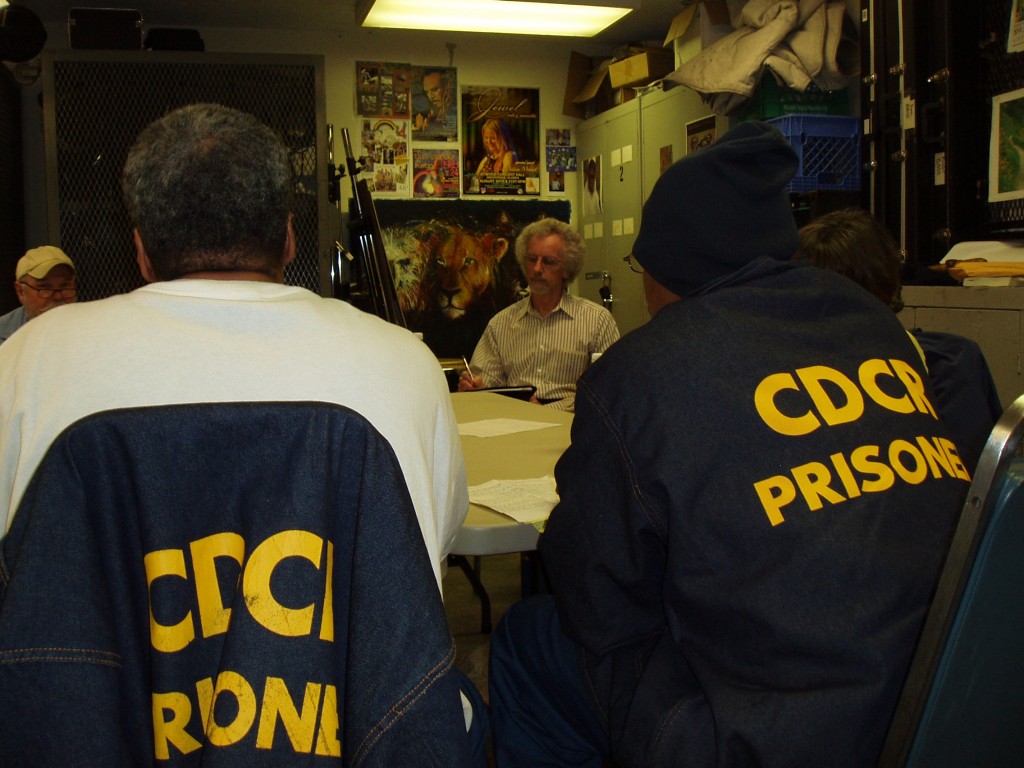 I began by telling them why I wrote the book, and what I’ve learned about grace over the years. Mainly, though, I came to listen. What could my book, written by a middle-class author of Christian popular theology, communicate to men who lived in an institution seemingly designed to enforce Ungrace? We all know the stories of violence, gangs, and bullying in maximum-security prisons. We know of racial conflicts that lead to lockdowns every few months in a place like Folsom. What could I teach them about grace? More important, what could they teach me?
“How would you like to be remembered for the worst thing you ever did?” one articulate prisoner began. “Even the downtrodden like us have to look down on somebody. I’ve learned that grace is not about being nice, it’s about being free. Outside of grace I’m full of harsh judgments about other people. With grace, I’m set free. Grace is the house I live in—I need it every day. I’m learning to invite others into that house now and then.”
Another man spoke up, “This place pushes you to become more of what you already are. It’s easy to spend your whole life in here blaming other people—the judge, society, your parents, whatever. I’ve had to face myself, and learn not to keep blaming. Life itself is a grace. The meals I get, even these meals, are a grace. I need to keep reminding myself.”
And another: “In here, grace is perceived as a weakness. You give somebody some grace, and immediately they ask, ‘What’s he want in return?’ Or show some grace, and others start counting on it as a kind of entitlement.”
One man kept interrupting with hostile comments. “You think only Christians have grace? Yeah, well what about Hell? What kind of God sends people to Hell? You call that grace?”
Most, though, showed thoughtfulness and surprising humility. “I marked one phrase in your book, that forgiveness is an unnatural act. You got that right. I’m in here for killing two people. I pray for their families to forgive me, for their sakes, not for mine. Until they forgive me, they let me and what I did control them. Only forgiveness will set them free. So far, they haven’t done that. It’s unnatural all right.” He thought a minute and added, “Without grace I’m a slave to my ancestors, to my anger, to whatever pissed me off this morning.”
The man next to him, a young African-American who will likely grow old in this place, choked up as he spoke. “I experienced some of that forgiveness just last weekend. According to California law, a co-defendant who accompanied you during a crime is just as guilty as you are. I pulled the trigger, but the guys with me got long sentences too. This weekend, the mother of one of my co-defendants visited me, and she forgave me. It’s unnatural.”
As our time drew to a close, one prisoner seemed to sum it up. “You have to look hard for grace in a place like this. Sometimes you have to dream it. I’m in for life without possibility of parole. Yet I can’t help dreaming of rolling hills, of a picnic with my family, of driving down a street. Maybe laws will change or a new governor will somehow grant me a pardon. It’s crazy, I know. Grace is like hope. You can’t live without it.”
Afterwards the men asked me to sign their books, along with some scraps of paper they could give their kids. Working full-time, they earn $25 per month, and a father behind bars has few gifts he can pass on. I shook hands with each inmate, wished them the best, and thanked them for their insights. Guards accompanied them back to their cells while we visitors reversed the routine of showing i.d., signing registers, and submitting to searches. Even the rattletrap van got a thorough going-over.
The sun had come out while we were in the prison, glistening off puddles left by a morning rain. We drove back through the lush green hills into freedom and headed for a nearby coffee shop before catching a flight home. I remembered a passage from Solzhenitsyn. Spending his first night outside after serving time in the Gulag, he lay in a comfortable bed and listened to sounds he had not heard for eight years: the click-click of a woman in heels walking on a sidewalk, the shrieks and laughter of children at play.
And off I walk! I wonder whether everybody knows the meaning of this great free word. I am walking along by myself! With no automatic rifles threatening me, from either flank or from the rear. I look behind me: no one there! If I like, I can take the right-hand side, past the school fence, where a big pig is rooting in a puddle. And if I like, I can walk on the left, where hens are strutting and scratching immediately in front of the District Education Department….
I cannot sleep! I walk and walk in the moonlight. The donkeys sing their song. The camels sing. Every fiber in me sings: I am free! I am free!
Folsom Prison presents an advanced test on grace, a free gift that only comes to those who pursue it, or at least recognize it. Clearly, some had passed that test.


Philip, thanks for your many meditations on grace. I spent 32 years in prison ministry and experienced remarkable grace. One night after sharing with a group of inmates, one heard my prayer request regarding my failing heart. He quickly spoke up and said, “I have a word from the Lord for you – it is Ezekiel 36:26, which says, ‘I will give you a new heart, and a new spirit I will put within you. And I will remove the heart of stone from your flesh, and give you a heart of flesh.'” Little did I know that night more than a decade ago that along the way I would have two metal hearts implanted over a three year period of time to keep me alive, and finally have a heart transplant, giving me a heart of flesh. Grace was needed every step of the way as I watched my son David suffer and then die at age 36 after a five year battle with hodgkins disease. The grace of God came ever so clearly into focus when I met the family of my heart donor, who at age 42 committed suicide by shooting himself in the head. Four people by God’s grace received organs and were granted life from one who did not want to live. Grace is ever needed – just a few short months ago, my wife Mary was diagnosed with stage 3 colon cancer and is in the midst of 6 months of difficult chemotherapy. God gave her grace two days after a chemo infusion to sing at a funeral. The moment inspired me to begin my second book about the personal grace experienced by our family entitled “She Sings Because She’s Happy” with a subtitle of “The Queen’s two day interlude amidst cancer and chemo.” I trust again by God’s grace, that it will be published in 2012. As I read your story tonight of your visit to Folsom prison, I see ever more clearly the grace I was given that night in prison long ago, when God ministered grace to me through a thoughtful and loving inmate. And I am amazed at God’s grace as the 17 year old son of my heart donor has stood with his ear against my chest, listening to the beat of his father’s heart in me.
After reading your “Amazing Grace” book, my son and I discussed at the length the meditative thought about “places of grace.” He would say to me or I would say to him, “we are in a place of grace.” The most amazing grace came one night when I had to share with him the bad news that his illness was so bad that no nursing home was willing to take him. His body was paralyzed and ravaged by “graft vs. host” disease from a donor bone marrow transplant. He said to me, “Dad, don’t worry, Jesus may come tomorrow.” As we sat in the darkness of his hospital room and prayed together that night, it was truly a “place of grace.” He would never be conscious to share with me again, dying just a few weeks later. He is now in heaven – the ultimate “Place of Grace.” I will be there with him too one day. And I plan to find the inmate brother who spoke words of grace to me, and thank him!
James Earp, Author of “The Governor’s Four Hearts”
“One man kept interrupting with hostile comments. “You think only Christians have grace? Yeah, well what about Hell? What kind of God sends people to Hell? You call that grace?” Most, though, showed thoughtfulness and surprising humility.”
I don’t doubt the man was hostile; but might the hostility be born of actually thinking about the doctrine of Hell?; something most Christians seem to have largely avoided. And why? It is a nightmare that we simply can’t keep in our minds; nor reconcile with the heart of Jesus expressed at Calvary. “Father, forgive them, for they do not know what they do.”
Hi Philip; Robert Taylor here. We corresponded back in 2002 regarding the boundaries and safeguards of grace.
Of all the authors out there, you most strike me as someone who has probably really wrestled with the doctrine of eternal torment. To be honest, for decades I held to the traditional view of Hell without ever thoroughly researching it or pondering it for very long. The last couple of years, however, that question has been at the center of my attention.
What if the traditional view of Hell is wrong? Then, I who so love grace would also personally have had a part in arguably the most toxic abuse in the history of the church.
Sadly, on the one hand, I have been part of the greatest ungrace imaginable. Joyfully, “God so loved the world that He gave His only begotten Son, that whoever believes in Him should not PERISH but have everlasting life.”
Traditionalism reads John 3:16 as if Jesus said: “should not be eternally tormented in the Lake of Fire.” Likewise, it trades death for torment in Genesis 2:17.
What is amazing is how explicit, repeated, and thoroughly the Bible teaches annihilation. What is just as amazing is how non-existent the case for traditionalism is. Proof-texts are taken out of context; words are redefined; theology is read into Scripture rather than being taken out of it. The reality is exactly the opposite of what one would expect, given the long history of the eternal torment view in the church; and the supposed cult status of annihilation.
I’ve been stunned and profoundly impacted by seeing the true penalty for man’s sin. It has deeply affected my view of God and my fellow man. Life-long conservatives, graduates from places like Multnomah and Emmaus, that have seen the exegesis are having the same experience.
Is Hell a place of perishing or eternal torment? My sense is that the church is finally ready for this question; at least a significant part of it.
I know you have many good things on your plate. But if you’re interested in exploring this topic, just let me know.
Robert
Now living in Napa, CA
2181 Euclid Ave, 94558
The comment by Robert Taylor posted April 16th is somewhat of a cliff hanger. I would really like to hear more on this topic. It is something that has been a struggling point for me.
Hi Phillip,
Thanks for documenting your visit to Folsom prison. It is wonderful when people from the outside get a chance to visit the incarcerated and share their stories. It helps remove some of the sensationalism that we are bombarded with by the media about prisoners.
I am a volunteer teacher in the Prison College program at San Quentin and also have help start a job placement and financial literacy course for inmates at the prison. Many of my students are serving life sentences, while others are preparing to leave in two to three years. Even lifers have a chance for parole (especially in this age of overcrowding).
I was wondering if you were aware of similar programs going on at Folsom. I have found that educational programs in CA’s prisons are few and far between, which I think is why our recidivism rate is the highest in the country. It would be wonderful to learn if there were organizations working at Folsom who were trying to help prisoners successfully reenter society.
Like you, I have always been amazed by how much work people in prison are doing to change their lives, both psychologically and spiritually. It sounds like your visit was very uplifting for the inmates (and perhaps you too). Thanks again for sharing your story.
Blessings–
Thanks for the article. I am a volunteer at Sing Sing and have to give a speech tomorrow on why I volunteer and what going into prison by “outsiders” can benefit both the volunteers and inmates. So, I am doing research on people’s experiences. The volunteers with whom I go every Sunday do not go as a religious group, although we do have a Meeting for Worship. We also share, as you did in the group you described. I think knowing someone cares, that others respect you for your inner humanity, that is what makes life-changing experiences for the inmates — especially those who have no hope of ever being released. Their anger can be diffused and the frustration lessened. NO guarantees, but knowing people come back week after week in any capacity does give much to those who go into prison. I still can’t exactly put it into words, but giving of oneself is the most precious gift, and I am convinced this does give back in special ways. You may think it’s religious, and for you it might be, but I just think it’s a bonding of the inner “light” (for want of a better term) which has been given to all of us, “insiders” and “outsiders.” So thanks again for your article and sharing your experiences. I hope you go again and again and again!