
You haven’t seen a new posting from me for a while and for a good reason. We have moved, and I’ve spent the last few weeks first packing then unpacking boxes, and in between times negotiating over help lines to the Philippines and India in order to get network, phone, cable, and computer systems up and running in a new house. Nineteen years in the same place leads to a lot of accumulation, and we’ve used this opportunity to winnow our belongings. As we’re learning, it takes almost as much work to move one mile as it does to move a thousand.
It is a good thing, I’ve found, to suspend the life of the mind for a few weeks and join the world of manual labor; after all, far more people in the world spend their work hours using muscles than using brain synapses. You sleep better, end the day sore yet with a feeling of measurable accomplishment, and eat anything you want without gaining weight.
I remember vividly our 1992 move from downtown Chicago to a forest in the foothills of the Colorado Rockies. We loved our life in the city, filled with concerts, theater, great restaurants, ethnic diversity, and a grace-filled church. Over time, though, the busy and crowded urban scene complicated my writing life. I had moved to Chicago as a young journalist and found the metropolis a marvelous place for journalism: I needed only to walk outdoors to find a mugging in process, or someone having an epileptic fit, or a homeless person eager to be interviewed. Eventually, though, I wanted my writing to move in a more reflective, personal direction, which the noise and frenetic pace of the city worked against.
We looked all over the United States and made what seemed at the time a risky decision to relocate to rural Colorado, where we knew no one, and begin a life dramatically different from what we had known in Chicago. We found a house on a hill with a view of snowcapped mountains to the west. We had to look hard to see signs of any other houses poking through the trees. We arrived a few days before the moving truck, and after unloading a U-Haul trailer with a mattress, two plates, two place settings, two suitcases, and my computer, we spent the first night in an empty, echoey house. Accustomed to the background noise of the city, we found it difficult to sleep amid such silence. The next day we awoke to a stunning sight: six inches of fresh snow had transformed the landscape into a glistening white wonderland. Think Narnia at Christmas—that was our front yard.

- The view we lose.
I have always found the natural world nourishing to creativity and, more, a pathway to worship. “The heavens declare the glory of God; the skies proclaim the work of his hands,” wrote the psalmist. It baffles me that places of great natural beauty do not foster religious faith—how can Oregon and Washington have the lowest church attendance of any states? Nature was one of the key forces that brought me back to God, for I wanted to know the Artist responsible for beauty such as I saw on grand scale in photos from space telescopes or on minute scale such as in the intricate designs on a butterfly wing.
When I would hit a block in writing, or experience grief and sadness over a friend’s illness or death, I would hike up to a pile of rocks behind my home and sit, looking out over an unspoiled landscape which reminded me that the world goes on in its fierce beauty, regardless of any crisis great or small. Several times a curious red fox discovered me sitting on that rock and squatted warily nearby, his golden eyes and twitching ears alert to any movement I might make. Once I stumbled upon a cluster of Calypso orchids, a rare plant that I had come across in the writings of John Muir, who recounted the two greatest days of his life as the time when he camped in Yosemite Valley with Ralph Waldo Emerson…and when he found a Calypso orchid on a hike. And I only had to look in my back yard.
My writing did take a more personal turn. My first books composed in Colorado were The Jesus I Never Knew and What’s So Amazing About Grace?, and then came others like Soul Survivor and Reaching for the Invisible God. Soon Janet and I began traveling internationally, more than seventy countries in all, and this too informed my writing. Home became a refuge, allowing us to venture to other places because we knew we could return to the welcoming solace of Colorado.
Initially the move took a toll on Janet, who had thrived in Chicago as a social worker heading up a senior citizens’ program. After a few months in Colorado she accepted new and challenging work as a hospice chaplain. Many nights a jarring phone call would interrupt our sleep (people die at inopportune times) and she would make the trek down the hill into Denver to attend the bedside of a dying person. Later she worked at an assisted living facility managed by Orthodox Jews.
Why, then, did we decide to move again this year? In a word, age caught up with us. We had lived on several acres, which meant managing a Ponderosa pine forest subject to beetle kill and blizzards. In the locally famous blizzard of 2003 seven feet of snow fell over a two-day period. As Elihu reminded Job, “He [God] says to the snow, ‘Fall on the earth,’ and to the rain shower, ‘Be a mighty downpour.’ So that all men he has made may know his work, he stops every man from his labor.” Indeed, everything stopped in our part of the world that week.
I went snowshoeing, lunging in the soft powder to make each arduous step, and stood atop a hill listening to what sounded like rifle shots echoing through the canyon. With a start I realized they were tree branches and whole trees snapping from the weight of snow and falling to the ground with a great whoosh. We had no electricity for a week, which meant no heat and no water since the well pump had lost power too. We stayed warm by burning wood and running a small gas fireplace around the clock. Each night for a few minutes we turned on a battery-powered radio and listened to reports of war, for that was the very week the U.S. had invaded Iraq. Reports from the desert seemed very far away as I looked out my window on the moonlit whiteness.
Shoveling snow, sawing trees, pushing a lawnmower up a 30-degree slope—all these things took a toll, so this year we decided to look for a place to spend the next season of life. Once again we considered other parts of the country, especially the Southeast where our families live. Frankly, we could not find a place more appealing than Colorado. We have spectacular mountain scenery, great snow, plentiful wildlife, few bugs, 300 days of sunshine annually, no air-conditioning, and wide open spaces with few traffic jams. Why go anywhere else? (I know, I know, I sound like a hack writer for the tourist bureau.)
At the same time we wanted to simplify our lives and find a more, ahem, age-appropriate place. In our search we found a townhouse that will involve much less maintenance. We traded in a well and septic tank for treated water and a sewer system. We gave away the lawnmower and now leave snow removal to professionals. We even know the folks in the adjacent townhouse who will share a wall with us. And I have room for my twenty-six bookcases in a large downstairs office area.

- The view we gain.
Life always involves tradeoffs. We have lost a view of year-round snowcaps but gained a mountain stream in our front yard. A fly fisherman with a strong arm and good aim could fish from our balcony; we’ll probably just sit on the deck and enjoy the view and the sound of rushing water.
The day before we moved, as if to remind us of that first magical day in Colorado in 1992, a freak October storm dumped a foot of fresh snow on our town. It delayed the move by several hours, as the moving truck had to send for chains to make it up our driveway, but when I took the first carload to the new place, I saw a sight reminiscent of our first morning in Colorado nineteen years before. I’ve included a photo of the stream cutting through fresh-fallen snow. As I stood at the window and watched, a herd of elk kicked their way through the snow to the creek for a drink. To my left, a kingfisher perched on a branch in search of trout small enough to swallow. Nature itself was sending a committee to welcome us.
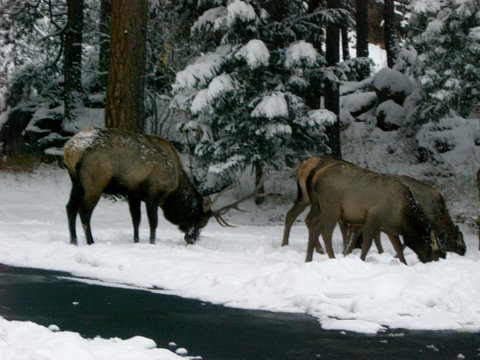
- The welcoming committee
We hope the future years in our new home prove as pleasant and productive as our last two decades have been. We still miss many things about Chicago and the urban life, yet Colorado has replaced those qualities with peace and solitude as well as a greater appreciation for the outdoors. We’re grateful for those advantages, and plan to enjoy them for, oh, the next nineteen years or so.


Awesome, I hope that you do enjoy the next 19+ years. I am enjoying your writings, especially the Jesus I never knew.
Hi Philip! 🙂 I sure know how it feels to detach yourself from the place you call home. But looking at your posted pics, I guess there’s not much adjustment for you and Janet with your new vicinity, coz they just look the same to me (or maybe it’s just the snow, hehehe). Anyhow, I pray you both will be refreshed in this change you’ve made, as you continue to refresh others with your respective ministries. Speaking of which, I echo Greg Denholm’s query there. I am soooo looking forward to your memoir!! Is it near completion already? 😀 I just finished reading EH Peterson’s memoir actually, and I found you and Janet in the acknowledgment list. Being a great fan of yours, I was hugely delighted to learn you both know each other (although I’m aware you’ve quoted him in your books)! So that’s how I thought of you making one. I really, really hope it would be available soon. 😀
Our unchanging Almighty God will bless and keep the both of you as you enjoy this change you’ve made. Keep on! 🙂
When you told me very briefly on your facebook page that you were in the process of moving, it concerned me as I continue pouring over the pages of “Reaching for the Invisible God,” seeing how productive the move to Colorado has been for you–even wondering this very night about your move. I also wondered about Janet, as I read that Chicago had been better for her (p.223). At the rate I read (re-read, analyze, and annotate), I was confident there was ample Yancey material for years of my perusal, but I became genuinely concerned for the two of you. Your post refreshingly allays my fears–so good to hear that you both are in a place where you can continue to thrive!
It is also obvious you touch a chord with several of your readers. One of them above sums it up, “I feel such a kinship with you.” In the words C.S. Lewis shared in “Shadowlands,” we similarly express ourselves; ‘We read to know we are not alone.’ I never understood this phrase until realizing that for me it only applies when I read YOUR books. You are the one who breaks things down honestly, with full integrity, with the courage to look a paradox in the eye and spell out both extremes as part of the answer, just as it is in reality. Thus we know you have dealt with it squarely, informing us of what we already know, paired with things we’ve only heard about, and as the icing on the cake, you educate us on matters we would have otherwise never heard and certainly not been able to fit into the mosaic of our understanding!
In a world where all others at some point cave in to demands for quick-and-easy marketable sound-bites and snippets, you stay the course to always be refreshingly honest and thorough, and thus it is so encouraging to know you have given thought to your needs and your service for the next twenty years (but what is with this mention of “stairs”? ;-).
Obviously, Philip does not know that a transcendent monotheistic entity that the human mind refers to as “god,” does not exist!
Read my latest book entitled: Did God Screw Up? You can Google it and purchase it worldwide from bookstores. If you wonder about the “god” of Judaism, Christianity and Islam…it is the same mythological entity…read about all the screw-ups, you’ll be enlightened forever.
Mr. Yancey:
I want to tell you that I am reading WHAT’S SO AMAZING ABOUT GRACE. Every time I pick it up and begin reading I find myself terrified about putting it down because I know I will be back in my own reality bereft of your monumental wisdom.
Thank you and may God’s grace be with you.
Dolores Fortino