
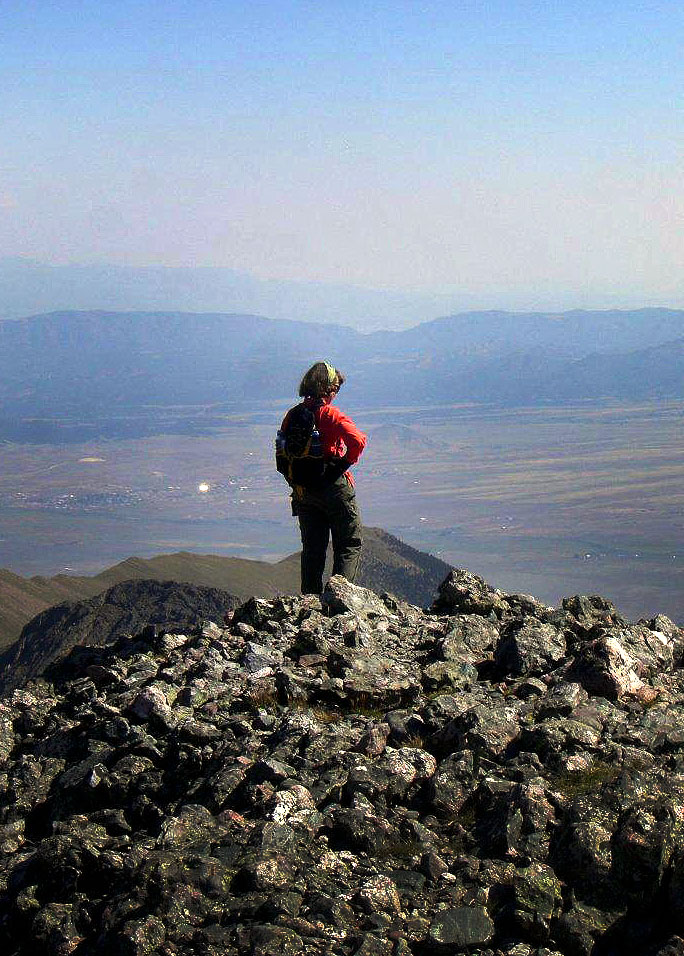
 After we moved from Chicago to Colorado a friend invited my wife and me to accompany him on a hike up a 14,000-foot (4,300-meter) mountain, one of 54 such “14ers” in Colorado.
Without thinking, we agreed. Sunshine Mountain barely makes the list, slouching in at a measly 14,001 feet. We hiked up, huffing and puffing all the way, then stood for a moment on the summit to catch our breath, awestruck by the glorious panorama of the Rockies that you only see from atop one. Invigorated, we hiked over to a neighboring peak, Red Cloud, took a “shortcut” down and learned a lesson about improvised shortcuts by finding ourselves stranded on cliff bands.
Since that day in 1993, we’ve climbed a few 14ers every summer. On the easier climbs the trail begins at 9,000-10,000 feet and it takes five or six hours to ascend the peak and three or four more to descend. The more remote mountains require a long hike to the trailhead and an overnight camp. Around a third of Colorado’s 14ers demand no real climbing moves, just a vigorous hike in reduced oxygen. Another third call on all four limbs to scramble up boulder fields and rock formations; the remaining third have scary exposure and can be downright dangerous.
As I mentioned in an earlier post, in 2007 I had an auto accident and for seven hours I lay strapped to a backboard while doctors tried to determine whether my neck fracture had nicked a major artery—if so, they said, I would die before they could get me to surgery. I make my living as a Christian writer, I thought. I should come up with some final reflections in case they are my last. I’m embarrassed to say that one thought overwhelmed all others: I can’t die yet—I’ve climbed 51 of the 14ers. I’ve got three more to go!
As should be obvious if you’re reading this, I didn’t die that day. Enter a new friend, Eric Alexander, who had trained and helped guide the first blind person to summit Mt. Everest. (You can read about Eric’s exploits on his website, www.highersummits.com.) Eric sent this message through a mutual friend: “If Philip needs any help climbing the last three 14ers, I’ll be glad to lead him.” I jumped at the chance, figuring that if he could get a blind guy up Mt. Everest he could get me up anything in Colorado. Later that summer, a few months after having my neck brace removed, I climbed my 54th and last 14er.
Or so I thought. You see, I had climbed ten of them without my wife, who suddenly got the bug. She had always claimed, “Philip climbs with the singular goal of reaching the top. I climb with the goal of identifying 25 species of wild flowers on the way up, and if I reach the summit, all the better.” When Janet learned how few women had completed all 54 peaks, however, she became more focused and together we attempted those last ten (some of them with the help of patient Eric). On September 16 this summer, at 9:26 am, we reached the top of Ellingwood Point, Janet’s last unclimbed Colorado 14er!
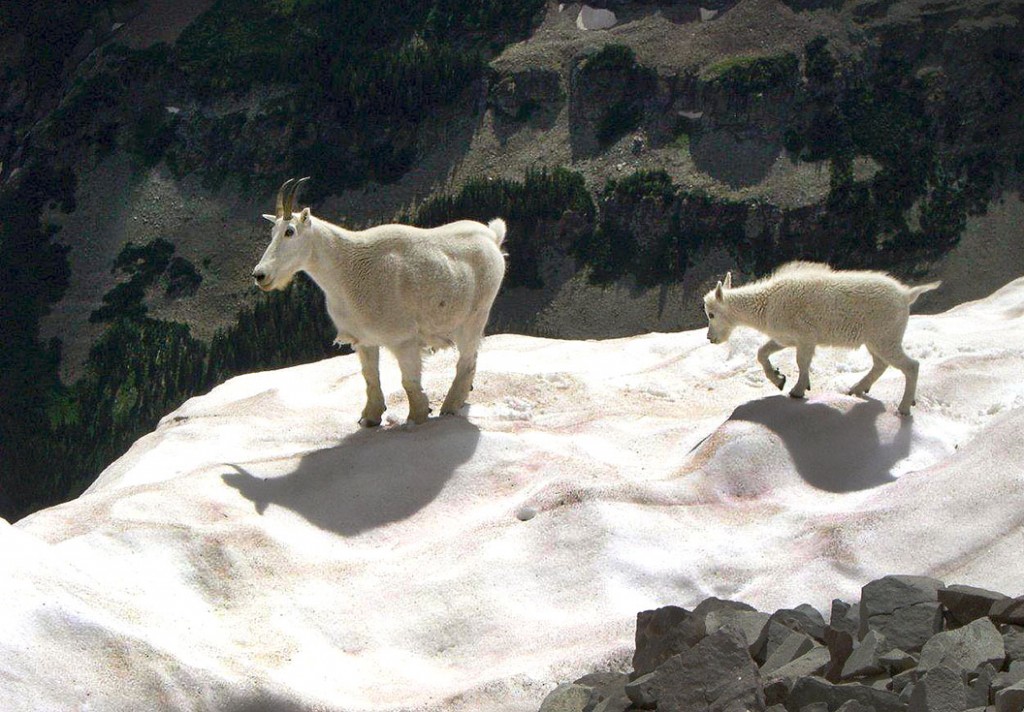 We have had some wonderful experiences along the way. We’ve seen bighorn sheep stand on their hind legs and head-butt each other with a sound that echoed like thunder. We’ve watched baby mountain goats scramble up in 20 seconds the same rock-strewn gully that took us 45 minutes to maneuver. We’ve lain on sleeping bags and tracked satellites across a Milky Way galaxy that sparkled like diamond dust. On the summit of one mountain we stood in complete quiet and heard the plaintive bugling of a bull elk hidden in the trees some 4,000 feet below. We’ve nearly stepped on a nesting ptarmigan, a bird perfectly camouflaged to look like a rock in the summer, only to lose its feathers and grow pure white ones for the winter snow. Early one morning we startled a flock of mountain bluebirds who flew up and suddenly caught the sunlight with an explosion of color like silent fireworks. You only get these sights by hiking into the wilderness, and then you realize you’re the only persons on earth graced by such a thrilling encounter with God’s creation.
The mountains have given me two indelible images of grace. Sometimes I’ve taken ill-advised detours and sometimes I’ve simply gotten lost. Wandering around in search of the trail, I’ll turn a corner and see a lush carpet of wild flowers: columbine, Indian paintbrush, elephant’s head, bishop’s cap. God has lavished this planet with beauty that shines forth whether anyone notices it or not. God is both a giver and an artist, and what God creates shouts back wordless praise, as the Psalms remind us.
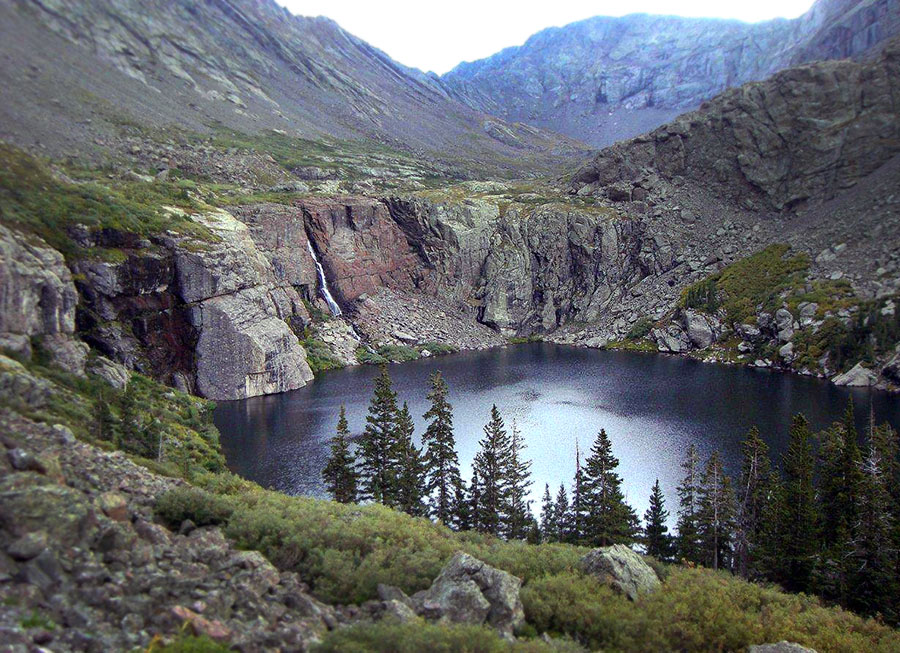
The second image comes from the water that begins in melting snowfields near the top, trickles down to form runnels, then lovely Alpine lakes, then streams, and finally roaring rivers at the bottom. Grace, like water, always flows down. You cannot read the Bible without hearing the loud message: God cares for the poor, the downtrodden, the oppressed, the humble, the needy—and so should we.
Of course, the mountains themselves are the main players in this drama. You keep looking up at the summit, gauging how much distance remains, checking clouds for the potential of deadly thunderstorms. Some mountains bear plaques memorializing a young climber killed by lightning. I have never been so miserable as the time I hunkered down under a rock overhang for almost an hour with an icy waterfall pouring down my back; my legs were cramping but I dared not venture out into the meadow, where lightning bolts were crashing like percussion bombs. And I have never been so terrified as inching along a tiny 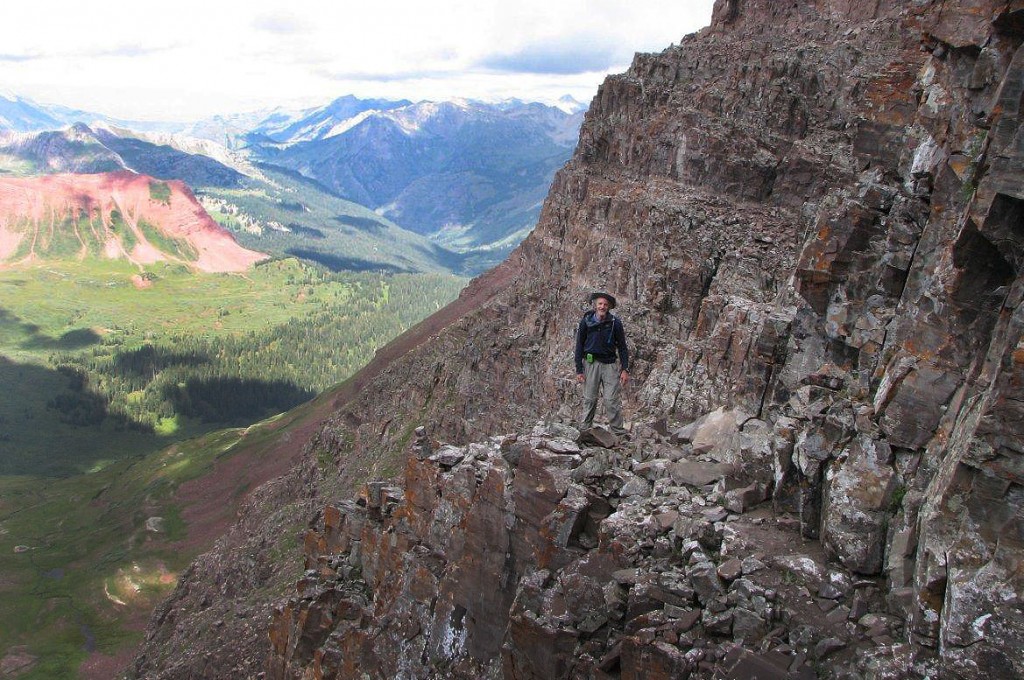 ledge trying not to look down at the thousands of feet of empty space below. Anne LaMott says her two favorite prayers are “Thanks! Thanks! Thanks!” and “Help! Help! Help!”; climbing offers splendid opportunities for both.
It’s hard not to think of the mountains as sometimes angry or sinister—a “pathetic fallacy” as the literature professors would say. (Indeed, the Psalms do not hesitate to use such pathetic fallacies: “Let the rivers clap their hands, let the mountains sing together for joy.”) Yet in truth, as the great climber Reinhold Messner reminds us, “Mountains are not fair or unfair, they are just dangerous.” Another renowned climber, Ed Viesturs, puts it this way: “Mountains don’t kill people, they just sit there.”
My wife likes to repeat yet another comment by Viesturs: “Getting to the summit is optional, getting down is mandatory.” Sometimes we’ve had to turn back a mere few hundred yards from the summit due to thunderstorms or wind, a wrenching decision when you know you’ll have to repeat the arduous climb at a later date. There’s a strong chance, however, that I survived to write these words because on occasion I did turn back, albeit reluctantly.
I have no desire to tackle other mountains, like Rainier, Denali, or (horrors!) Everest. Janet and I had no idea when we first ventured up Sunshine Mountain what would lie ahead. We’ve experienced the magnificent state of Colorado from its 54 highest peaks, and that is more than enough. Our boots have lost their tread, our hiking poles are bent, our legs bear the scars of unstable rocks. Our bodies—and yes, our marriage—have passed a difficult challenge. Writing from the comfort of my basement office, I feel like we’ve reached the summit. Somewhere I read this observation from a fellow adventurer: “Climbing a 14er is like love—anticipated with pleasure, experienced with discomfort, and remembered with nostalgia.” Indeed.


Congrats to both of you! Glad your knee has mended enough that you could tackle the climb.
You continue to be a source of inspiration!
Best wishes.
My latest book is titled, “The Greater Jesus.” And, yes, I quote your book, “The Jesus I Never Knew” several times. Would you be interested in a review copy. You can check it out on Amazon.com. Here’s the description:
This compelling new book addresses this most relevant question—What is Jesus like and doing today? The author first suggests that to get to know someone, anyone, it is important we learn about their past—what they were like and what they did. But what is more important is what they are like and doing today. Why so? It’s because people change. Well, so has Jesus. Yet every week in churches around the world people gather to hear a story. For almost two thousand years that story has been told and retold. It’s about a man named Jesus of Nazareth—his birth, life, death, and resurrection. It’s been dubbed “the greatest story ever told.” Make no mistake, that story is important—very important. It’s about a real historical human being—the historical Jesus—Who walked, breathed, and left huge footprints in the sand of history and in the lives of countless billions ever since. But that story is also 2,000-year-old history! He’s not like that anymore! This book unveils and lays out what Jesus, the contemporary Christ, is like and doing today. It also challenges its reader, throughout, and concludes by asking—Which Jesus will be the Jesus you now follow?
Hi Philip,
Congratulations to you and your wife on so many successful climbs. I’m a fan of Colorado, the Rockies and your work. My husband, two young children and I were in Colorado–Denver and Colorado Springs–in mid-September. On Sept. 18 we made our way to the summit of Pikes Peak. I thought we were brave just driving up! At the summit we struggled with altitude sickness; we’re from Chicago, so 14,110 feet wreaked a little havoc on our bodies. I’ve never fainted, but I felt very close to it that afternoon. I was so moved by the experience of rarefied air that I likened it to my faith walk as a motherless daughter. It’s harder to breathe up on the mountaintop, but so much easier to hear God. As I’ve grieved, and continue to grieve, my mom who died 23 years ago, sometimes it’s hard to breathe. But the grief gives me a sharper view of God.
Funny how life is.
Thank you for capturing another side of the mountains. One I didn’t see, but I find fascinating. I’m a bit of a wimp when it comes to hiking up to great heights, so I appreciate your perspective. And I applaud your bravery. It takes oodles of faith to climb even one mountain.
Your writing is the best I’ve seen. I’m a journalist, too, and if my work is someday a tenth as good as yours, I’ll count myself successful.
I thank God for you! Blessings to you and your wife.
Kristina Cowan
Naperville, Ill.
I saw your profile on LinkedIn, Kristina, and you’re well on the way. Like you, I traded the corporate world for freelancing, and have never looked back. Climbing mountains is like writing: the more you do it, the less rarefied that air seems.
Philip
The perspective from which I customarily appreciate the natural world is inherent in the word that I use to describe it: “outside.” Ahhh, indoors … no rain, wind or mud in winter, and no flies, heat or sunburn in summer! But here’s some news, Philip: you might have made a convert today. You’re having way too much fun out there on the other side of the window.
Just by mere chance, I’m given your The Jesus I Never Knew as a possible title for a Christological research of mine… I’ve read a few pages via Amazon and looks enticing, possiby for its amicable way of presenting contents. It must be the “evangelical” way, I suppose, which is a very American type of approach, totally unknown to us in Europe — “born again” must be a concept coined in the U.S., I’m sure.
And yet, I want to give it a chance: this brief note just to let you know I’ll buy the book, if only for the beautiful epigraphs! (Simone Weil’s being one of the most moving – but perhaps I’m biased, being of Jewish background myself).
I reserve my critical,/i> comments for after the reading, naturally. One way or the other, I’ll let you know… Ciao!
Philip