
 I visited a local megachurch recently. My friend described it as, “You know, one of those big-box churches with one-word names, super-loud music, huge video screens, and long sermons.” Currently, 1300 U.S. congregations qualify as megachurches, averaging more than 2000 in weekly attendance. The one I visited has more parking-lot volunteers than my church has members.
I’ll say one thing for megachurches: they can afford quality. The sermon was both entertaining and insightful, the super-loud music flawless (I declined the earplugs that were considerately offered at the welcome booth), and those parking volunteers got us in and out in record time.
Yet the majority of Americans, like me, still attend churches with less than 200 members. We show up on Sundays to hear less entertaining sermons and less professional music—though we have no trouble finding a parking place. Why? Smaller towns don’t have the option of megachurches, of course, and big crowds make some people nervous. I found one more reason when I came across this paradoxical observation in G. K. Chesterton’s book Heretics:
The man who lives in a small community lives in a much larger world…. The reason is obvious. In a large community we can choose our companions. In a small community our companions are chosen for us.
Precisely! Given a choice, I tend to hang out with folks like me: people who have college degrees, drink dark roast coffee, listen to classical music, and buy their cars based on EPA gas mileage ratings. Yet after a while I get bored with people like me. Smaller groups (and smaller churches) force me to rub shoulders with everybody else.
Henri Nouwen defines “community” as the place where the person you least want to live with always lives. Often we surround ourselves with the people we most want to live with, which forms a club or a clique, not a community. Anyone can form a club; it takes grace, shared vision, and hard work to form a community.
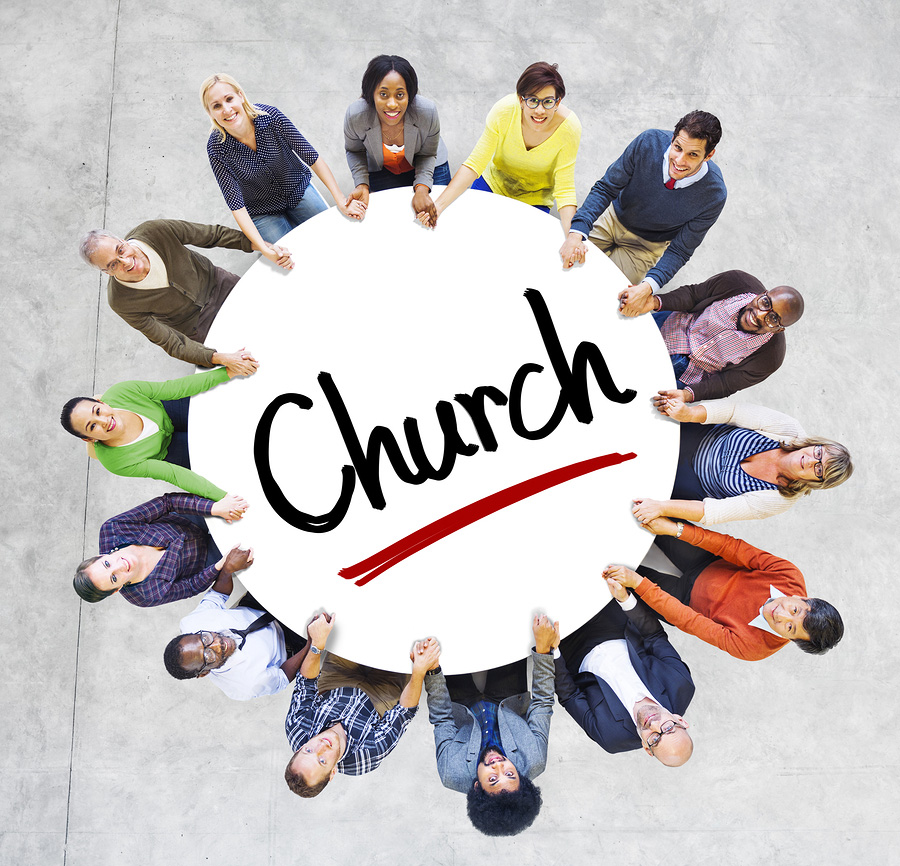 The Christian church was the first institution in history to bring together on equal footing Jews and Gentiles, men and women, slaves and free. The Apostle Paul waxed eloquent on this “mystery, which for ages past was kept hidden in God.” By forming a community out of diverse members, Paul said, we have the opportunity to capture the attention of the world and even the supernatural world beyond. (Ephesians 3:9-10)
In some ways the church has sadly failed in this assignment. (Yes, Billy Graham, 11 o’clock Sunday is still the most segregated hour in America.) But even monochrome churches show diversity in age, education, and economic class. Church is the one place I visit that brings together generations: infants still held at their mothers’ breasts, children who squirm and giggle at all the wrong times, responsible adults who know how to act appropriately at all times, and senior citizens who may drift asleep if the preacher drones on too long.
I know one megachurch that tries to seat people based on their commonality: senior citizens down front where they can hear better, single adults over there where they can meet each other, families with young children in the back where they can exit quickly if the kids make noise. That strikes me as all wrong. I deliberately seek a congregation comprising people not like me, and I find such people less avoidable in smaller churches.
 hesterton’s insight about small communities appears in a chapter on “The Institution of the Family,” which gives a whole new slant on family values. “The common defence of the family,” he writes, “is that, amid the stress and fickleness of life it is peaceful, pleasant, and at one. But there is another defence of the family which is possible, and to me evident; this defence is that the family is not peaceful and not pleasant and not at one.”
The smallest units in society, families offer an ideal laboratory in which to test out Chesterton’s principle that “the smaller the community, the larger the world.” Reflecting on my own family’s reunions, I must agree that the institution of the family forces me into close contact with characters I would otherwise avoid. I have no choice about such encounters; we share a gene pool.
 Several of my family members have served stints in prison. Some carry on feuds that go back generations. A few spin elaborate tales to cover up unwed pregnancies. Geographically, my family extends from Philadelphia to San Jose to Australia. It includes a drug addict and a professional football player with an estranged gay son, a Ph.D. in Philosophy as well as several who never graduated from high school. Methodists, Church of Christ, Unitarian/Universalists, Independent Baptists, atheists─they all come together at our reunions.
I have learned more about grace, forgiveness, diversity─and, yes, social deviance─from my family than from all the theology books I have read. Chesterton’s point, exactly. Troublesome issues like divorce and homosexuality take on a different cast when you confront them not in a state legislature but at a family reunion.
Those Christians who trumpet “family values” need to make clear that we are not proposing a lobotomized society of Stepford wives and their offspring. We recognize that families consist of imperfect human beings. We simply contend that the family, the smallest social unit, represents a good place to confront those imperfections.
Some commentators have attacked the entire institution, blaming society’s problems on the dysfunctions of the family. Such jeremiads miss the point: family is not a perfect institution by any means but simply a place that accepts its members on a single criterion, shared DNA. From such a tiny group we can learn the principles of true community needed in larger groups.
We have many examples of what happens when enlightened people get together and devise large institutions to improve on the family. These social engineers want everyone to be alike, sharing common values and beliefs. Consider extreme versions of the “politically correct” movement on university campuses. Consider the thought police in Communist North Korea. Making people more like they “ought to be” is the great experiment of modern times.
Any parent could tell you that making just one child more like he or she “ought to be” is a dicey proposition at best. If the smallest unit in society has trouble reforming individuals, should we trust the largest institution, the government? Better to work things out in small communities, where we may have less choice about our companions─but so does everyone else.


I spent 35 years in large churches. Plenty of money and programs and people to meet if you wanted. Or you could hide if you wanted to. It never seemed to bother me that I never met more than ten percent of the attendees. I was friends with the lead pastor at one of them, so I never had to worry about seeing and talking with him. I never realized that it took an appointment for everyone to see a pastor at all, much less the lead pastor. I really thought I was happy and I kind of looked down on the small churches.
Then God, in His wisdom, through some very odd circumstances led me to a small evangelical church plant. I had spent my church life up to that point at Assembly of God churches and in my state of pride, looked down on evangelical churches. It completely transformed everything about me. This church of about 50 adults and 25 kids taught me what real Community is about. This group of people taught me to love others. Everyone in this community learn to serve each other, work together, and love God together. We are led by a totally humble pAstor and his wife. They are very special people who lead by example. No one in this church goes without needed things of any kind. Worship is beautiful and we learn God’s word together. Prayer is the main focus of the church and we work, laugh, grieve, celebrate and serve together. It can get messy at times and difficult, but God has always helped us to find a way. I’m still here after 5 1/2 years and have no wish to leave. I have matured hear more in the last 5 1/2 years than the previous 20 years and a large church. We are now in the process of being joined with a Southern Baptist church. This is been an amazing move of God. We are still under 125 people at this point.
My church is The Bridge Community Church of South San Jose ca.
The church we are merging with is Oak Grove Baptist of South San Jose
The two greatest Commands are:
Love GOD with all your Heart, Soul, and Mind.
Love each other.
…in that order.
It would seem as though small groups have easier times to live that. And as a testimony to that commitment, they would grow (God gave the increase). The biggest challenge of a larger “community”, that I’ve observed in many megas, is that they start losing focus, because it’s much harder to focus, on God and become so occupied with people… if that makes sense. But many small groups have that issue as well, thus never grow.
They would do Church-ianity rather than Christianity.
Some say that Christ came so God can build relationship with Man, but Man sets out to build Religions. Then Men use religions to control other men. There’s some truth to that.
It’s a lonely world and people are craving for relationships, which is part of the demand that leads to church growth. The trick in church leadership, it seems, is to lead people into a growing Relationship with God first, consistent with the order of two greatest commandments… Seek ye first the Kingdom, then all these things shall be added. Our problem is that we seek each other first.
But I would say that if large group is so easy to keep in tune with God, then you and I would less likely to hear of Christ. Perhaps break ups and persecutions are part of God’s plan to proliferate the Gosple to better coverage in humanity, so people like me can have a chance to hear.
I guess that God leads us to the right Church where we can be fruitful. Since we “Got outof the boat” and moved to bigger premises, then set up services to the poor such as food banks and debt counselling, the Church has grown to fill where we now are. People have stepped up to serve in excellent ways, and our fun days and reputation for helping our Community has opened doors we could not have imagined. Our services have doubled in attendance from 200 to 400 and many people have come to know Jesus.
Only by depending utterly on Jesus instead of ourselves was this even possible
Although we reach out to help Churches in Zambia and India we have also helped our local Baptist Church and it’s new Pastor so there are now two rapidly growingChurches in town. Many members moved to the Baptist Church in the process but we kept on growing anyway.
I would like us to plant more churches in nearby towns as prophesied over us and in God’s time I trust we will.
The one lesson for us has been that the more we give away, the richer the harvest.