
 Gina Welch is a smart, young, citified Jewish writer who grew up in Berkeley, California, and graduated from Yale. In a desire to know more about evangelicals, whom she kept running into when she moved to Virginia, she decided to attend Jerry Falwell’s Thomas Road Baptist Church in Lynchburg. As a bonus, she thought her unlikely pairing with Falwell could provide the grist for a book. In her words, “I considered him a homophobe, a fearmonger, a manipulator, and a misogynist—an alien creature from the most extreme backwater of evangelical culture.” (Falwell described himself as a fundamentalist, not an evangelical, a distinction lost on most in secular culture.)
As for Welch herself, “I cuss, I drink, and I am not a virgin. I have never believed in God.” A neophyte to religion, Welch didn’t know you could just show up at church. She thought you had to qualify somehow, like pledging a sorority or being invited into a country club, so she signed up for a Connections class designed for people interested in membership. Soon she found herself immersed in an exotic subculture with its own rules: no swearing, drinking, smoking, premarital sex, plunging necklines, spaghetti straps, facial piercings, short skirts, or R-rated movies.
At first the lingo confused her: insider phrases such as “feed my lambs,” “soul-winning,” and talk about spiritual gifts. Over the next months she played by the rules (mostly) and faked her way into a singles ministry called EPIC: Experiencing Personal Intimacy with Christ. She attended worship services, learning in time to appreciate the rousing “praise music” that at first seemed jarring and distasteful. With some misgivings she went forward for conversion, got baptized, and even volunteered for a mission trip to Alaska, all as part of her undercover journalism and without revealing her true identity.
Predictably, Welch encountered some things that made her uncomfortable. Her initial introduction to the ministry of Thomas Road took place around Halloween at an elaborate haunted house called Scaremare which featured fake aborted fetuses, attack zombies, and an actor hanging on a cross with his head lolling on his chest. Fear seemed ubiquitous, with Falwell predicting the rapture in 2006 and a Gospel magician delivering a scary talk to children about hell. In one of her most unsettling experiences Welch presented the plan of salvation at Children’s Church, reciting such phrases as “Jesus the savior took our sins to the cross,” and “The Bible says, ‘and without the shedding of blood is no remission.’” She adds, “When I finished my segment I virtually ran to the side of the room.”
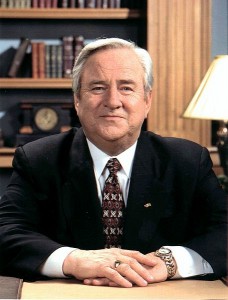 Though she objected strongly to Falwell’s politics and cringed at his fundraising techniques and hucksterism, over time she found herself captivated by his charm and charisma, so much so that she felt genuine sadness at his death in 2007. She dared not tell her other-world friends about his effect on her, for they were repulsed by his right-wing views and the anti-gay policies of his church and his school, Liberty University. “Unable to explain the odd couple of my affection for Jerry Falwell and my loathing of his ideals,” she nevertheless attended the memorial service after his death.
To her credit, Welch genuinely wrestled with the main points of evangelical theology. The Trinity baffled her, as did the Atonement: How could Jesus taking on our sins satisfy an angry God? She listened to her teammates explain the gospel in Children’s Church. “The message—it’s okay that you do bad things, because everyone does bad things, and everyone can be forgiven, but you should try to be as good as you can be anyway—was a nice one. But the phrasing of it—Jesus loves you in spite of the fact that you’re a dirty rotten sinner—how could that provide children with solace?”
Everywhere she turned, theology seemed a conundrum. The Bible contains apparent contradictions but is inerrant; we are completely forgiven but still must do good works; Jesus died to please God yet somehow was God. The book that records her experience admirably avoids a tone of condescension about doctrine and those who believe it, though in the end she remains unconvinced.
—#
I have read other undercover accounts of evangelicals reported with far less empathy. Indeed, Gina Welch accepts at face value the transformed lives of those she meets: a former cocaine addict now a student at Liberty University, recovering addicts serving on the staff of a rescue mission, couples who selflessly adopt children as part of their pro-life commitment. After she herself responds to an altar call in order to seek baptism, she writes, “I was supposed to have a kind of flinty satisfaction and sense of homecoming, as if I could fall into the crowd and be received in a soothing embrace as intensely familiar as a relative’s laugh. But I felt more like a knock-kneed fawn at a meeting of wolves, my wolf-hide disguise slipping out of place. Because even though I had just had my first hint of what Evangelicals feel that make them so passionately devoted, and even though it would be some time before I found myself called upon to pray out loud, I was still not a Christian.”
 Eventually Welch did learn to pray out loud, a terrifying experience that she prepared for by practicing at her desk at home. She liked the sense of calmness that prayer produced, and even the informality that evangelicals use in talking to God. The friendliness, optimism and, yes, genuine happiness of the people she got to know surprised her. As she recalls, “what I envied most about Christians was not the God thing—it was having a community gathering each week, a touchstone for people who share values, a safe place to be frank about your life struggles, a place to be reminded of your moral compass. Having a place to guard against loneliness, to feel there are others like you.”
The worship services eventually won her over too. She was amazed by the church members’ generosity in giving and their passion in singing. Some raised their arms high in the air, like rockets about to take off, alarming her at first until she decided that people at sports and political events showed just as much passion with less at stake. The stirring song “Days of Elijah” became one of her favorites.
After almost two years Welch abruptly ended her experiment. Friends at the church were hurt that she broke off contact, not even returning their phone calls. As she turned to writing the book, her experience at Thomas Road continued to affect her. Impressed by what she had learned about forgiveness, she met with a former teacher to seek reconciliation over a past dispute. She watched old services on her laptop and to her horror found herself singing along. “I felt awful if I slept late on Sundays, couldn’t figure out how to organize my day, couldn’t relax. I missed hearing Ray [one of the pastors] preach. I really missed my friends. I missed the warmth, the easy smiles people offered me when I walked into the room. I missed singing at the top of my lungs in church…. I was sick from lying. I had a sour stomach all the time.”
In a revealing passage, Welch describes the effect of hearing a sermon on Psalm 139. “God-love, the love in the psalm, the love in Jesus loves you—that was Mobius strip love, love with no beginning or end, love that was both calm and complete, unflinching in the face of anything you could reveal about yourself. Who wouldn’t want that? I certainly did, especially in that moment—knowing the secrets in my own heart, knowing that soon they’d be revealed.” She ends the moment of longing and vulnerability with this line: “But wanting it still didn’t make me believe it.”
After a long break, almost two years of no contact, Gina Welch returned to Thomas Road and met separately with a former friend named Alice and with Pastor Ray, who had guided her during her stay there. She came clean, telling them of the project, sparked by her desire to write a book that would help people understand evangelicals better. She admitted the deception, the questionable ethics of what she had done. She ended the project after the trip to Alaska in part because she felt uncomfortably close to the people she was lying to and in part because she knew it was wrong to feign belief in something others staked their lives 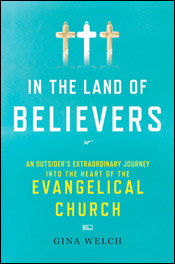 on. They took it well. Pastor Ray even prayed for her, and for the book, which would be published the following year as In the Land of Believers: An Outsider’s Extraordinary Journey into the Heart of the Evangelical Church.
The conversation with Alice took a different tack. Alice talked about her feelings of abandonment, of betrayal. “I thought we were friends,” she said. She imagined Gina looking at Caller ID and deciding not to answer her calls. Welch apologized for hurting her, but not for the project itself. She quotes Joan Didion: “Writers are always selling somebody out.”
Church had changed her, Welch admitted to her friend Alice. She writes, “I loved having that sense of community and also that serious, regular self-inquiry. Our relationship had changed me; feeling so happy in our friendship had made me think differently about Christians. But just like her, I couldn’t imagine ever believing anything other than what I believed. I had no choice in that.”
—#
I learned a lot from In the Land of Believers. Aside from its dubious ethics, her project offers a fascinating and instructive glimpse into a subculture that is rarely examined so respectfully from the outside. In fact as I read her book I recalled my own days growing up in exactly the opposite environment from Gina Welch. I knew virtually no one but evangelicals. I too had to learn the Christian phrases that soon became clichés, went forward again and again wondering if this time might be genuine, practiced praying aloud to sound spiritual, puzzled over my lack of feelings during such solemn events as baptism and the Lord’s Supper. Those who grow up in the church and those who approach it as a sociological experiment face the same danger, that it may become a comfortable pattern of behavior insulating us from reality rather than expressing it. Jesus criticized the most spiritual people of his day, the Pharisees, for precisely that.
Through the grace of God, and after a time of tossing aside the subculture like a stifling and unwelcome costume, I found that the words and practices can convey reality as well as hypocrisy. I must disagree with Welch’s conclusion, “I couldn’t imagine ever believing anything other than what I believed. I had no choice in that.” Surely we do have a choice, and Welch made one in turning away from what she observed at one particular church.
Even so, Welch’s account reminded me of the true attraction of the evangelical church to someone who approaches it with inbuilt hostility. In the New Testament, Jesus, Paul, John, and James each stress one principle above all others: Love God and love your neighbor. Church surveys show that 80 percent of all conversions come about as an outgrowth of friendship. Thomas Road follows the Southern Baptist tradition of programmed evangelism, yet all the expensive and well-designed programs of evangelism combined produce only a fraction of the results of simple friendship. In the words of Tim Keller, “Don’t think in terms of what used to be called friendship evangelism. Think in terms of friendship. Your evangelism should be organic and natural, not a bunch of bullet points and agenda items that you enter into a conversation hoping to get to so you’re almost like a marketer.”
I doubt Jesus keeps track of how many theological arguments his followers win; he may well keep track of how we love. Even the Apostle Paul, who worked as hard as anyone in history to bring people into the kingdom, had to admit, “If I have the gift of prophecy and can fathom all mysteries and all knowledge, and if I have a faith that can move mountains, but do not have love, I am nothing.” Gina Welch has moved on to other writing projects, and I imagine the mysteries and knowledge she heard about in Lynchburg will gradually fade away. Her experience of being loved, even by those she deceived, likely will not.


As a pastor in a church plant, I think I would find her observations valuable. We’re not just playing in a different ballpark now; we’re playing a different game completely and often trying to do it with the same equipment. I love the Mobius strip image. I love that she can’t get away from God, either. You can’t play at God without him taking the game very seriously.
Philip, I am a huge fan of your writing and your philosophy about life/spirituality in general. I so appreciate your posting this. I look forward to reading this book in hopes of gaining insight into my own distrust of the church itself. I love God and have always appreciated the church community, but have been absent from it for many years due to the body’s inability to accept me as a gay person. (Loved your ch. 13 of Grace, by the way! Thank you for that!)
I was entrenched into the church (call it fundamentalism or evangelicalism — it was much the same to me) for decades until I came out of the closet and received only judgment and cold shoulders. All of the rule following seemed great until it came to people actually applying the ANSWER to the question of, “What WOULD Jesus Do?!”
And in some cases, it is not all that clear, I grant you that. But He did make it clear to love our neighbors, among countless other verses.
I don’t miss all the legalism, EVEN THOUGH MY PERSONAL LIFE HASN”T CHANGED ONE BIT — but I do certainly miss that community that is found in many churches — the BODY which is fellowship and encouragement and support and so on.
I have an appreciation for this woman’s quest to see what it was all about, and DESPITE her “dubious ethics,” I do applaud her for coming clean and letting folks know what she had done before she simply went and published the book.
Thank you for always pushing many of us to THINK and examine our hearts!
Peace, ~ Julie
Thanks for this, Julie, and for not giving up on the faith despite the treatment you’ve received from the church. As I wrote in my comment to Tracy, I saw many parallels between Gina’s experience and that of gay people in the church. I like your spirit.
Philip
Another very thought provoking post Philip, and several of the replies have also got me thinking. Thanks everyone! Certainly I find it odd to think of inviting someone who is un-churched into this strange world of Sunday mornings and mid week meetings that so many of us inhabit. Philip, on a related topic, I’ve been challenged, comforted and equipped by your books, is there any possibility that you might consider tackling the subject of evangelism / outreach in a book with a similar manner to Prayer at some point in the future? Best wishes from the mountains of New Zealand.
Hi, Philip. When I first saw your blog title, I thought you might be writing about Unlikely Disciple by Kevin Roose. It’s interesting that Kevin and Gina were both undercover in Lynchburg at about the same time, although Kevin was actually enrolled as a student at Liberty U. Probably the most heartwarming thing, to me, is that both authors seem to walk away with a lot of positives–community, grace, love. Seeds planted for later on?
Right now, I’m finishing up What Good Is God? … and especially enjoyed reading “Student Daze.” Lots of connections for me there, brother.
Best wishes from VA.
Thanks for the great reading over the years. Have you ever written about how our faith evolves over the course of our spiritual journeys? I came to Christ in college during the 70’s, searching for meaning at a time where so many of us were disillusioned. We found that meaning by following Jesus, and we were out to change the world. I became very active in church and ministry, but over the years I have felt less and less “evangelical” and have struggled with issues I used to be sure about, such as heaven and hell, Jesus being the only way to know God, etc. It’s not so much a case of doubt or being wounded by some of the craziness of the subculture, it’s just that I feel that I’ve grown in a different direction. I think it would be interesting to have some kind of follow-up study of the “Jesus People” from the 60’s and 70’s to see what spiritual roads have been taken. Well, thanks again for the wonderful encouragement over the years.