

Some forty years ago, when I lived in downtown Chicago, I wrote this reflection on my aquarium. It became a kind of parable with special significance in the Christmas season. A shorter version made its way into one of my books; here is the original.
When I look out my downtown window I see a twelve-story apartment building, all concrete and glass, its balconies speckled by a random assortment of bicycles, Weber grills and lawn chairs. Closer, I see twisted metal antennae growing like bare branches from a video store, the pebbly gray roof of a Donut shop, the aluminum exhaust vent from an Italian restaurant, and a web of black wires to bring electricity to all these monuments of civilization. (We didn’t choose this place for the view.)

But if I turn my head to the right, as I often do, I can watch a thriving tropical paradise. A piece of the Caribbean has snuck into my study. A glass rectangle contains five seashells coated with velvety algae, stalks of coral planted like shrubbery in the gravel bottom, and seven creatures as exotic as any that exist on God’s earth. Saltwater fish have colors so pure and lustrous that it seems the fish themselves are actively creating the hues, rather than merely reflecting light waves to produce them.
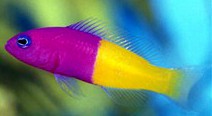
The most brightly colored fish in my aquarium is split in half, with a glowing yellow tail and a shocking magenta head, as if he had stuck his head in a paint bucket.

My tastes tend toward the bizarre, and in addition to beautiful fish I have two that are startling but hardly beautiful. A long-horned cowfish, so named because of the horns extending from his head and tail, propels his boxy body around with impossibly small side fins. If a bumblebee defies aerodynamics, the cowfish defies aquatics.

Another, a lion fish, is all fins and spikes and menacing protuberances like one of those gaudy paper creatures that dance across the stage in Chinese opera.
I keep the aquarium as a reminder. When writer’s loneliness sets in, or suffering hits too close, or the gray of Chicago’s sky and buildings invades to color my mind and moods, I turn and gaze. There are no mountains out my window, and the nearest blue whale is half a world away, but I do have this small rectangle to remind me of the larger world outside. Half a million species of beetles, ten thousand wild butterfly designs, a billion fish just like mine poking around in coral reef—a lot of beauty is going on out there, often unobserved by human eyes. My aquarium reminds me.
Yet even here, amid the beauty of my artificial universe, suffering thrives as well. Nature, said G. K. Chesterton, is our sister, not our mother; she too has fallen. The spikes and fins on my lion fish are appropriately menacing; they can contain enough toxin to kill a person. And when any one fish shows a sign of weakness, the others will turn on it, tormenting without mercy. Just last week the other six fish were brutally attacking the infected eye of the cowfish. In aquariums, pacifists die young.
I spend much time and effort fighting off the parasites and bacteria that invade the tank. I run a portable chemical laboratory to test the specific gravity, nitrate and nitrite levels, and ammonia content. I pump in vitamins and antibiotics and sulfa drugs, and enough enzymes to make a rock grow. I filter the water through glass fibers and charcoal and expose it to an ultraviolet light. Even so, the fish don t last long. Fish make dubious pets, I tell my friends; their only “tricks” are eating, getting sick, and dying.

You would think, in view of all this energy expended on their behalf, that my fish would at least be grateful. Not so. Every time my shadow appears above the tank, they dive for cover into the nearest shell. Three times a day I open the lid and drop in food, yet they respond to each opening as a sure sign of my designs to torture them. Fish are surely not affirming pets.
The arduous demands of aquarium management have taught me to appreciate what is involved in running a universe based on dependable physical laws. To my fish I am deity, and one who does not hesitate to intervene. I balance the salts and trace elements in their water. No food enters their tank unless I retrieve it from my freezer and drop it in. They would not live a day without the electrical gadget that brings oxygen to the water.
Whenever I must treat an infection, I face an agonizing choice. Ideally, I should move the infected fish to a quarantine tank in order to keep the others from pestering it and to protect them from contagion. But such violent intervention in the tank, the mere act of chasing the sick fish with the net, could do more damage than the infection. Stress resulting from the treatment itself may actually cause death.
I bought my aquarium to brighten a dull room, but ended up learning a few lessons about running a universe. Maintaining one requires constant effort and a precarious balancing of physical laws. Often the most gracious acts go unnoticed or even cause resentment. As for direct intervention, that is never simple, in universes large or small.

I often long for a way to communicate with those small-brained water-dwellers. Out of ignorance, they perceive me as a constant threat. I cannot convince them of my true concern. I am too large for them, my actions too incomprehensible. My acts of mercy they see as cruelty; my attempts at healing they view as destruction. To change their perceptions would require a form of incarnation. I would need to become a fish.


Loved the parable and the illustrations, thank you
What a wonderfull likeness of our precious savior and a bit of what he deals with in humans. Thanks for sharing your insights gives me something to think about and a deeper understanding of our patient Lord.
Philip, this piece by far is my favorite of all your writings. My mother gave me your book “I Was Just Wondering” for Christmas 1989 (which contains this story) in loving memory of my father Art Volle who had recently passed away and thought so highly of you. I still have this book with her hand written note to me, and it is still one of my most treasured books! Over the years I have shared this parable of your aquarium with countless Christian friends and also many of my non Christian friends, many of whom are agnostic/athiest. To me you have captured the essence of how the idea of God is just too much for our small brains to comprehend. You have also captured the heart of the Christmas story and the need for an incarnation. Thank you for sharing this story once again.
Thank you for this wonderful piece. I look forward to your posts and love your books. May you enjoy a blessed Christmas
Love it!!!!
I do not have a salt water aquarium, though I did at one time when I lived on Guam.
I now have a red eared slider turtle and can identify with your parable.
Thank you!!