

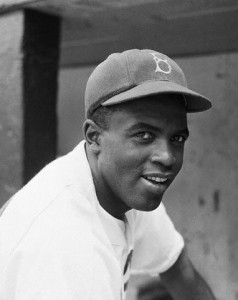
 Last week I saw the movie 42, the story of Jackie Robinson, the first black major league baseball player. Critics have found fault with 42 for being predictable and simplistic, but for long stretches while watching I had a lump in my throat, a lump of remorse and shame. You see, I grew up in Atlanta, Georgia, in the tumultuous days of the civil rights movement.
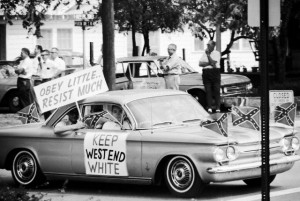
 The Jim Crow culture that shocked Jackie and his wife as they traveled in the South was the accepted environment of my youth. Although Atlanta had almost equal numbers of black and whites residents, we ate in different restaurants, played in different parks, and attended different schools and churches.

By law black people could not serve on juries, send children to white public schools, use a whites-only bathroom, sleep in a white motel, sit on the main floor of a movie theater, or swim in a white swimming pool. Motels and restaurants refused service to African-Americans, and gas stations had three rest rooms: White Men, White Ladies, and Colored.
My high school was named for a Confederate general, and when I graduated in 1966 no black student had ever set foot on campus. We believed that Malcolm, a short kid with a crew cut who wore metal taps on his shoes and loved to pick fights, singlehandedly kept them away. Reputed to be the nephew of the Grand Dragon of the Ku Klux Klan, Malcolm had put out the word that the first black student in our school would go home in a box.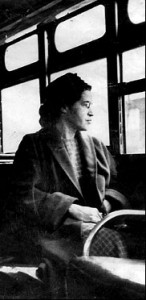 When I rode Atlanta buses, workmen and maids sat dutifully in the rear section and were required by law to give up a seat if a white rider wanted it. In neighboring Alabama, blacks had to enter the front door to pay the driver, then exit the bus and walk outside back to the rear door —until the bus boycott led by the courageous Rosa Parks.
Those who grew up outside the South may find the mean racism in 42 incomprehensible. Actually, it was worse than the movie depicts. As a high school student I attended a political rally held at a fairgrounds racetrack. Sponsors had brought together such luminaries as Alabama’s governor George Wallace and a national officer of the ultra-conservative John Birch Society, as well as Atlanta’s own 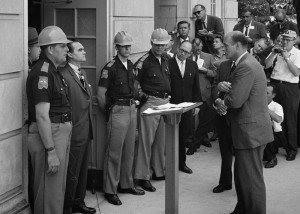 Lester Maddox (who would later serve as Georgia’s governor and run for President). We waved tiny rebel flags and cheered as the speakers denounced Washington for trampling states’ rights. A group of twenty black men, showing bravery such as I had never before seen, showed up at that rally just to observe. They sat together in a conspicuous dark clump in the bleachers.
Shortly after a rousing rendition of “Dixie,” hooded Klansmen arose from the crowd and began an ominous climb down those bleachers, surrounding the cluster of black men. The blacks looked around in vain for an escape route. At last, frantic, a few of them started climbing a thirty-foot chain fence designed to protect spectators from the race cars, and the Klansmen scrambled to catch them. The speaker’s bullhorn fell silent, and we all turned to watch the Klansmen pry loose the clinging bodies, as though removing prey from a trap. They began beating them with fists and with ax handles like the ones Lester Maddox sold in his fried chicken restaurant. After a time, a few Georgia State Patrol officers lazily made their way over and made the Klansmen stop.
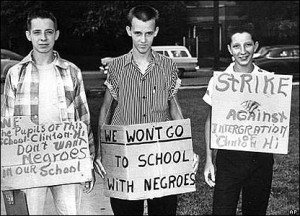 Today I feel shame, remorse, and also repentance. I grew up talking about “nigras,” not African-Americans, and swallowed the doctrine taught in my church that blacks were inferior, cursed by God. It took years for God to break the stranglehold of blatant racism in me—I wonder if any of us gets free of its more subtle forms—and I now see that sin as one of the most poisonous, with perhaps the most toxic societal effects. When experts discuss the underclass in urban America, they blame such things as drugs, changing values, systemic poverty, and the breakdown of the nuclear family. Sometimes I wonder if all those problems are consequences of a deeper, underlying cause: our centuries-old sin of racism.
Traveling to other countries helped me see that the poison of racism is near-universal. Finns tell jokes about Swedes, who tell country-bumpkin jokes about their Norwegian neighbors, though to a non-Scandinavian they all seem alike. The Japanese look down on Filipinos while Chinese and Koreans bear historic grudges against the Japanese. On my first trip to the pristine nation of New Zealand I turned on a radio station only to hear Kiwis speak about the Maoris with words that could have come from the American South: “Now, I’m not prejudiced or anything, but just look at how they keep their houses and yards. They’re dirty people, they don’t take care of things.”
 In the movie Mississippi Burning, Gene Hackman plays a good ole southern boy who says, “If you ain’t better than a black man [only he uses the N word], who are you better than?” He adds, “Everybody’s got to be better than somebody. It’s just human nature.” Black people gave us Southerners someone to look down on, someone to mock and feel superior to. My family moved every year or two when the rent went up, and lived sometimes in government projects and sometimes in trailer parks. Sociologically, we may have qualified as “poor white trash.” But, our only solace, at least we were white.
 n 1947 a brave young man named Jack Robinson was asked to take on the racist establishment of major league baseball, which the movie 42 portrays in all its ugliness. Branch Ricky, a cigar-chomping Methodist who understood showmanship as well as Christian ethics, selected Robinson from a pool of equally talented African-Americans because of his character.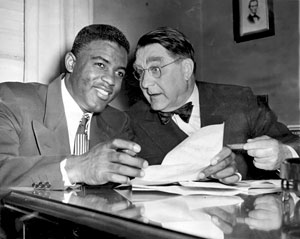
In a climactic scene, Robinson asks, “You want a man who doesn’t have the guts to fight back?” No, Ricky replies, “I want a man who has the guts not to fight back.” Though the movie doesn’t show it, he proceeded to read a devotional passage about the Sermon on the Mount in which Jesus replaces the age-old formula of “an eye for an eye and a tooth for a tooth” with the far more radical principle “turn the other cheek.”
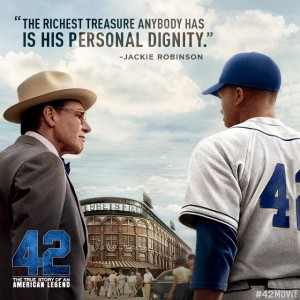 That first year, Robinson had much opportunity to put Jesus’ principle into practice. Pitchers aimed fastballs at his head, opposing managers taunted him with obscenities and racial slurs, fans booed him, his own teammates organized a boycott against him. Day after day, Robinson later admitted, he would get on his knees and pray for endurance and patience.
Observers of the South sometimes speak of it as “Christ-haunted.” Perhaps they should speak of it as “race-haunted” as well. All of us, white or black, who grew up in the South in those days bear scars. Some black people, beaten by truncheons and bitten by police dogs, bear physical scars. We whites bear spiritual scars. Although I have not lived in the South for forty years, I live with its memories, like the medieval murderers who were forced to wear the corpses of their victims strapped to their backs. The entire nation bears scars. Who would suggest that we have achieved racial harmony, anything like “the beloved community” that Martin Luther King Jr. longed for?
 I once visited King’s old church in Atlanta, Ebenezer Baptist, and sat in tears as I saw through new eyes the moral center of the black community that gave a group of people the strength to fight against bigots like me. I was on the outside in those days, cracking jokes, spreading rumors, helping sustain a system of evil. Inside the church, and for a time only inside the church, the black community stood tall. My eyes, blinded by bigotry, could not see the Kingdom of God at work.
 In November 2008 I toured the museum in Memphis built around the motel where Martin Luther King Jr. was assassinated. For several hours I revisited the scenes I had known as a teenager coming of age in the South. I stood beside the Formica lunch counter salvaged from Greensboro, North Carolina, and watched videos of the college students who had sat on these vinyl seats as thugs stamped out cigarettes in their hair, squirted mustard and ketchup in their faces, then knocked them off the stools and kicked them while white policemen looked on, laughing. On a nearby screen I saw the eerie scene of black children flying weightless through mist in Birmingham, Alabama, propelled by high-powered fire hoses, as snarling German Shepherds lunged toward them.
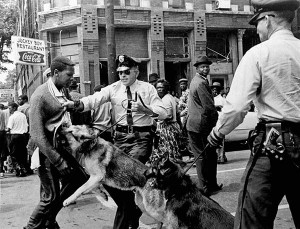 One room displayed a bus from Montgomery, Alabama, like the one in which Rosa Parks had refused to change seats, its two sections demarcated “Whites Only” and “Colored.” Another room displayed a larger bus charred black, the actual Greyhound burned to a crisp by an Alabama mob intent on chasing away the Freedom Riders, who were trying to integrate transportation. As the bus burned, the mob held its doors shut, hoping to incinerate the young riders inside. With help from highway patrolmen the Freedom Riders escaped, though badly beaten with iron pipes and baseball bats, only to have the local hospital turn them away.
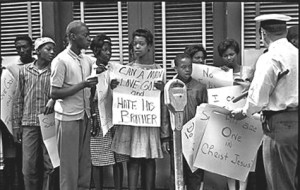
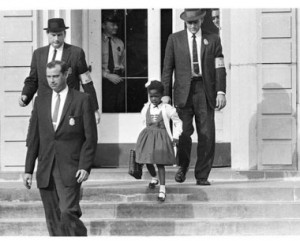 Looking back, it seems incredible to imagine such ferocity directed against people who were seeking the basic ingredients of human dignity: the right to vote, to sit on a bus, to eat in restaurants and sleep in motels, to attend college. With shame I recalled cheering along with classmates at my all-white high school as Southern sheriffs arrested the “outside agitators” of the civil rights movement.
On the grounds of the museum, the hauntingly prophetic words from King’s final “I have been to the mountaintop” speech are forged in steel, words that caught in my throat on a sunny day mere hours after Barack Obama got elected: “I may not get there with you, but I want you to know that we, as a people, will get to the Promised Land.” The day after he delivered that speech King died in a pool of blood on the very spot where I was standing, on the balcony of the Lorraine Motel.
The world of 2013 is a different place than that of 1947. My high school has since been renamed for a black astronaut; my church that once barred black visitors eventually sold their building to an African-American congregation. People of any color can eat, sleep, go to school, and drink from water fountains wherever they want. The U. S. shocked the world by electing an African-American President. These seismic changes in racial attitudes worldwide trace back to a few brave individuals who stood against the tide: Rosa Parks, Martin Luther King Jr., Nelson Mandela, Gandhi, and yes, in his own way, Jackie Robinson.
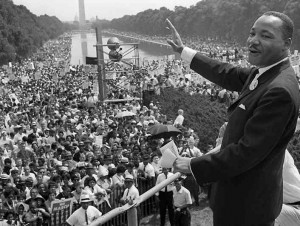 And what role did the church play in this the central political drama of the 1960s? The civil rights movement had religious roots and was led by ministers like King who challenged an unjust system from the outside; in the tradition of biblical prophets they appealed to a higher law than the ones written by legislators. Some white Christians joined the leaders on the front lines in Selma, Alabama, and Jackson, Mississippi, while others worked within the system to overturn unjust laws—but not all did so.
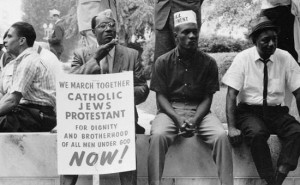 The church I attended while growing up in Atlanta took pride in the purity of its evangelical theology, and yet on this issue most church members came down solidly on the wrong side. Like many white churches in the South, mine stubbornly opposed the civil rights movement. It amazes me that slaves from Africa so readily adopted the religion of their owners and that African-American churches thrive today; surely the whites’ gospel must have sounded like bad news at times rather than good.
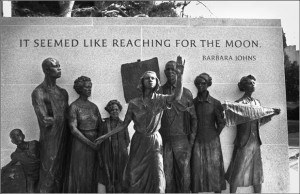
It took Southern Baptists 150 years to apologize for their support of slavery, and not until November 2008—two weeks after Obama’s election—did Bob Jones University admit their error in barring black students before 1971 and banning interracial dating until 2000. “We failed to accurately represent the Lord and to fulfill the commandment to love others as ourselves,” said their president Stephen Jones. Those words of apology apply to me and many other evangelicals who opposed the civil rights movement.
I could not help wondering, as I viewed the exhibits at the museum in Memphis, how much of the average Christian’s politics gets formed by surrounding culture rather than by the gospel of Jesus. As Stephen Jones further admitted in his apology,
…for far too long, we allowed institutional policies regarding race to be shaped more directly by that ethos than by the principles and precepts of the Scriptures. We conformed to the culture rather than provide a clear Christian counterpoint to it.
Thank you, Jackie Robinson and all the others, for showing us a different way, for providing a clear Christian counterpoint to a culture of violence, racism, and Ungrace. And God, open our eyes to the planks in our eyes that still blind us on other issues.


Hi Philip,
Thanks for your passionate and honest article about racism.
My country, Australia, also has a racist past (and to a lesser extent, present). At one time there was a “White Australia” policy, and at another, Aboriginal children were forcibly removed from the homes of their parents and placed in institutions, some run by the church, in a misguided attempt to assimilate them to white culture. This gave rise to the “Stolen Generation”, to whom Prime Minister Kevin Rudd formally apologized on February 13, 2008.
Racism is very topical here at the moment, in particular with regard to sport. During a recent Australian rules football match, a 13-year-old girl in the crowd called an opposing Aboriginal player an “ape”. The player heard the remark and reported her, and she subsequently apologized. Later, the President of the club she supports shocked everyone by suggesting in jest that the player who had been racially vilified should be used to promote a current stage production of King Kong. He is still trying to live that comment down, and will face a hearing over it.
Racism thrives in modern Australia: our national ethos of egalitarianism (“a fair go for all”) so easily morphs into legalized uniformity, or disapproval of anyone who is different. But like you say, Philip, it’s a universal issue.
Why is this so, I wonder? The massive scale and scope of the problem make me think that its source must be something that we all have in common. I can only think that it is the sinful nature: the “monster” within each of us that wants ruthlessly to be godlike—at the expense of others, if need be. And what more obvious way of categorizing people to facilitate our goal of self-aggrandizement than ranking people according to race? It allows us to elevate ourselves at the expense of those who don’t fit our particular brand of perfection, so bolstering our claim to inherent righteousness, even divinity.
If the sinful nature is at the heart of racism, the only solution to it is the one who came to defeat sin and its effects—Jesus. What do you think?
Mr. Yancey, you are one of my favorite authors. Your books “Soul Survivor” and “What’s so Amazing about Grace” helped bring me back from a point of dissilusionment with God and Christianity. I admire your authentcity in your books and the way you bring the message of God’s love through Jesus out into the open so simply and in a refreshing manner. Thanks for your books. I also loved “Dissappintment with God – three questions no one asks out loud”.
Thank you for putting into words the shame I have felt from growing up in the south and having lived those shameful times. I could have written that story. I have lived all over the world and know from experience the prejudice exist. I left Louisiana when I was 19 and moved into a society where my husbands boss was a man of a different race…. until that time I had never personally spoken to a black person. When you are away from the home you know and love you find out friends don’t have color they have relationships. Recently, I returned to Louisiana after being gone for 40 years and find for the most part there is still hidden and public prejudices. I was amazed and thrilled that the election of President Obama had stirred a confidence among the people here that I had not yet seen. If we as Christians could get ahold of the 2nd command that God gave us to love our neighbor as our self and the 1st to love God with all our heart, strength and mind….. everything else would fall into place. Thank you for this article which I will share.
I appreciate Glen’s comments, as well as Yancey’s essay. Bigotry is something everyone is prone to practice, however subtly. It is a symptom of the fallen world we live in. I like to say I was not raised to be “racist”, but the temptation to put others down to raise my own pride is always there. “They” or “He” or “She” may take a different form. Jesus is the only answer to this.
Phillip, this is a moving and penitent summary of humanity’s root problem – the desire to judge others in order to make ourselves feel superior in some way. Thank you for blunt honesty and your wise connection of racism and all prejudices to Jesus’ teaching on the need for us to remove the plank in our eye so that we can see clearly the speck. The dramatic size and scope of the plank from your youth in Atlanta is stunning but all too common in the course of history. As you say, it is the culture, not Scripture, dictating these norms. This truth remains alive and well today with regard to gays and other issues that Christians famously attack. As Mother Teresa once said, “When you judge people, you have no time to love them.” May God continue to bless your work and your ministry. In peace, John Kuypers