
A few days ago I got a letter from a Croatian man who introduced himself as the translator of my book What’s So Amazing About Grace? into Croatian. He asked if I would write a preface for the book specifically for Croatia.
“You have referred to the Croatian/Bosnian/Serbian experience during the recent war,” he said. “Although the war ended over 15 years ago, the wounds 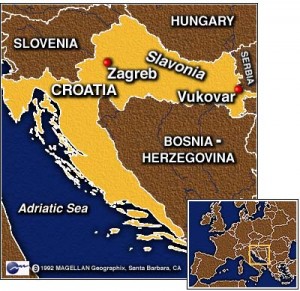 are still here and we are very very far from true reconciliation.” He went on to say that Christians in the Balkans are still struggling with truth and justice, and wonder whether grace can apply without the prior steps of truth and justice.
The Balkan countries still celebrate war criminals as heroes of the nation, often with the church’s approval. Rapes, tortures, concentration camps, ethnic cleansing—these memories of war still haunt the landscape. The translator asked, How can we “do grace” in such a setting? More, how can we keep another Balkan war from breaking out again in several decades?
I did write the preface, beginning with these paragraphs:
If I had originally envisioned this book for a Croatian audience, it would be a different book. How so? I cannot say for sure. The Balkans do not need an American writer to barge in with a limited understanding of your history and culture and offer advice.
For this reason I present this book as a kind of dialogue with you the reader. I depend on you, indeed I urge you, to take what I set forth in these pages and apply them to your own country. At times, as you read, you may find yourself shaking your head and saying, “He doesn’t understand Croatia!” You are right—I don’t. But you do, and it is up to Croatians to come to terms with your recent past as well as your distant past.
I went on to say that as an American I can offer some hope. After all, I grew up in the southern state of Georgia, which endured a brutal campaign by General William Tecumseh Sherman, whom some historians credit as introducing the modern “scorched earth” tactics of total war. His troops burned my home city of Atlanta to the ground, and all over Georgia you can find bronze markers recalling the destruction his armies inflicted during their March to the Sea.
 My Philadelphia uncles used to taunt me by asking me to book them a room in Atlanta’s “General Sherman Hotel,” which of course did not exist. We viewed Generals Sherman and Grant as war criminals, and in school we were even taught to scorn President Abraham Lincoln, who had forcibly reunited a divided country. The Georgia state flag incorporated the design of the Confederate flag, and I went to a high school named for a Confederate general. A popular bumper sticker in my childhood featured a cartoon figure of a Confederate soldier with the words, “Hell, no, we ain’t forgettin’!”
Before the Civil Rights Act forced change, we southerners also trampled on the rights of citizens from a different race. In a genteel version of ethnic cleansing, we fought in the courts and sometimes on the streets to keep them out of “our” restaurants, churches, neighborhoods, and schools. One race used to own the other, and I can hardly imagine a starker example of “Ungrace” than the slave trade that brought millions across an ocean to serve wealthy plantation owners. Visit the modern city of Atlanta today, however, and you will find few vestiges of that kind of racial division and regional patriotism. It takes time but wounds heal, justice triumphs, change happens.
Historian Shelby Foote points out that only after the Civil War did Americans start saying “The United States is…” rather than “The United States are….” Our identity as one nation came out of our  bloodiest war. Indeed, I recently learned that the burning of Atlanta played a crucial role in that re-union. Exhausted by war, the Democratic Party of 1864 adopted a platform calling for peace negotiations based on recognizing Confederate independence and nominated General George McClellan to oppose the beleaguered President Lincoln in that year’s election. News of Sherman’s September triumph in Atlanta helped swing popular support back to the Republican incumbent Lincoln, who pursued the war to its conclusion.
More recent times show that the same pattern of healed wounds can apply internationally as well. Two of America’s closest allies are Germany and Japan, the two nations who opposed us in the most destructive war in history. U. S. ties are strengthening with Vietnam, another nation who fought us in a bitter and bloody campaign. I have witnessed similar scenes of reconciliation in places like Germany, where East and West reunited, and in South Africa, where under the leadership of Nelson Mandela a majority race chose the way of truth but not revenge and in the process forfeited justice for the sake of reconciliation.
For these reasons, I have hope for Croatia and its neighbors. Fortunately, Croatia has outstanding scholars and pastors who are seeking how best to apply theology to their nation’s history. Among the most insightful is Miroslav Volf, who emigrated from Croatia to teach at Fuller Seminary in California and then at the Yale Divinity School. The End of Memory, a magnificent book, includes his comments about memories of the traumatic past: “They need not colonize the present nor invade the future by defining what we can do and become. Past wrongdoing suffered can be localized on the timeline of our life-story and stopped from spilling forward into the present and future to flood the whole of our life.”
Grace is the only force I know of that can block the toxic influence of a painful past on the present and the future. As Volf says, “For in the light of Christ’s self-sacrifice and resurrection, the future belongs to those who give themselves in love, not to those who nail others to a cross.”
For years the Balkans have been a laboratory of what I call “Ungrace,” the law in relationships that echoes one in physics: Every action causes an equal and opposite reaction. You have lived with the deadly consequences of that law for centuries. Can the modern Balkans become instead a laboratory of grace? And what would that look like?


Hello, Mr. Yancey.
I’m a Japanese Christian living in one of the Southern states in the US for about three years since I got married to my NY state born Christian man. He’s been in this state for more than 20 years but he hasn’t got any Southern accents and tells me that sometimes he still feels like he hasn’t got accepted by people here.
I’ve been struggling with my church life here. I’m not saying that saying “God bless America” is wrong— rather I think it’s normal to pray for our own countries. But I tend to get daunted when I hear so-called “Christian” people in churches here say (1) that they (US people) ARE special and the rest of the people in the world are NOT; (2) that they should be protected by God; (3) that their dropping of two A-bombs was right since it saved 2 millions of American soldiers’ lives (even though about 100,000 lives in Hiroshima and 70,000 lives in Nagasaki were lost at those times and there have been more lives lost each year since Aug, 1945); and (4) that their “SaviorS” are Jesus AND their troops. I don’t have any intentions to argue whether dropping the bombs was right or not. But sticking to the idea that “WE WERE RIGHT” or “GOD WAS WITH US (whatever they do since He granted them)” matters to me.
I was born after WWII and of course I didn’t experience anything real during the wartime. But our parents and grandparents have told us how hard it was. On the other hand I’ve also tried learning what terrible things my country did to so many nations (especially to neighboring ones) and at Pearl Harbor. These wrongdoings could never be the ones to be justified even if we had had been a Christian nation, I suppose. My nation killed so many lives so brutally — while those precious lives are God’s, not ours.
I was also discouraged and shocked when our Sunday school teacher said that one of the Ten Commandments “You shall not murder” does not include killing civilians in a war so it is justified. Until then I had not known that the verb should be ‘murder’ but not ‘kill’ because the Bible in our language uses a general word to mean “kill” for that verse. And then I thought ‘no wonder general (or at least some conservative) American Christians wouldn’t hesitate to go so aggressive in wars, to be honest. While those people loudly argue about abortion “to protect yet-to-be-born” lives given from God, why are they blind the preciousness of other already born lives somewhere out there in the warfare? To me they seem to be ‘fear-driven’ since they seem to want to exterminate those whom they think they can’t cope with. I wonder if they fear of ‘losing control over the world’ if at all.
Even though we hate certain people, God loves them and this is what we Christians learn from His Word, isn’t it? Why can some people claim that they are the only special ones to be always protected while they claim they are Christians who are to learn to love their neighbors?
Some people’s somewhat hard-core “WE WERE RIGHT” idea seems to go on to say “we are ALWAYS right” to justify themselves in their present and future acts.
It’s really challenging for me to be a Christian here. Every time some people pray “God bless America”, I’d like to pray “God bless all the nations in this imperfect world” and “May You grant us to have citizenships in Heaven”.
Having said all these, I reckon this is my training given to grow enough to be able to forgive those who say “hard-core” stuff since we are all imperfect.
I thank God that we have a Christian writer like you to share our questions and struggles along with our walk at this difficult age.
Hi dezi, your comments struck a chord with me. I’ve had this conversation before, with my career army officer husband, recently retired. There are two questions, one regarding the dropping of the bombs, and the other regarding the lack of prominence in our minds that this fact holds, that we are the only nation to have dropped atomic bombs on civilian populations. We don’t make much of that fact, but there it is, nonetheless.
I am a US citizen by birth but grew up in Europe during the Cold War. I guess I’ve retained a sense of being wedged in the middle at the mercy of two superpowers, and I’ve also retained a sense of the awfulness of that power. I entered this marriage a wanna-be pacifist, educated in a mennonite influenced school, but unwilling to live in a world where our military just vanished, knowing that I want the security it offers. I live in a place of continued internal tension.
I really don’t see any war as consistent with Christian values, not even the Revolutionary War (which, being foundational to our nation, no American church congregation I’ve ever sat with/among is sympathetic towards questioning). But at the end of long conversations, I can begin to see the human suffering and anger that war is an outgrowth of, the thing that precipitated the war in the first place, and the actions taken during war to bring them to an end (even as the war also causes more suffering.) Then too, I have seen wonderful values represented in the lives of the military people I’ve rubbed shoulders with. The word “service” for many is aptly chosen. Also, many of the Christian service members see themselves on a mission to bring Christ to others in the military, and they view their deployments to war zones primarily in terms of the humanitarian works they will have occasion to do. (We all seek greater meaning for our lives.) Some of the young families remind me of the young families I’ve encountered who are engaged in missions work. One such family even told their kids that their dad was going overseas for a year because God had some people for their dad to help over there. (As a child of missionaries, I raised some cautions there, for the sake of the children, but it didn’t seem I was heard.)
I still don’t understand the ease with which many Christians enter the soldiering profession. I guess what I’d like to tell you is that, yes, there is a place in the US where patriotism and faith/religion converge, yes, it is bizarre, yes, some others do see it too, and that it may be if you find resources to study this “patriotism as religion,” you will not feel so alone in dealing with it. Patriotism as religion often does interfere with the religion we know that wishes to bring all tongues and peoples together in their worship of Christ. Patriotism is inherently dividing, not uniting. And in the end we truly are saying, “our lives were more important.” That is still my conclusion about the “we had to do it, let’s move on” position. We as humans have loyalties that center first around the family, and then the immediate geography, and the country, and only then “the species.” I’m not sure that’s entirely valid, but it certainly is common.
But what I’ve found by living in the military community this past decade, where I really was scared of the brand of patriotism I might find, is that it helps when you don’t see just the surface but listen and listen and listen. You finally get brief glimpses of “the other side.” I lost a neighbor to the war in Iraq. I watched others lose friends. I watched amazing spouses throughout long and difficult and sudden deployments. My respect for them is immense. And they are “my neighbor.” It is easy for me to think about my “could’s and should’s,” but they have enormous and difficult commitments that they live out every day. Living in the military environment has definitely been a “cross-cultural experience” for me. I see I am not writing about the same type of experience you are writing about here, as a Japanese person living in the US and dealing with the comments of church members, but you are not alone in seeing incongruity here, and I do hope you will find more people to process it with and more ways to study it, for I really do think it helps to step back and study it as a cultural phenomenon, and recently, as one occurring in a nation engaged in war. The question is broader than I’ve made it. You certainly hear a lot of biblical language applied to the US in the mainstream, the US as a “city on a hill.” Wish I knew of resources to send your way to help as you process all this in the difficult position of being a foreigner in a strange land!!
A very interesting piece Philip and one that resonates deeply with me as someone who lives in Northern Ireland and who works within the peace and reconciliation “sector” in this part of the world.
The story of Northern Ireland and it’s peace process is incomplete- its political and community landscapes are still pock-marked with the legacy of the conflict. That having been said it has been amazing for me-someone who grew up with the worst of the violence to have witnessed the drip-feed of grace bringing gradual but marked change to this small and troubled country.
Change is possible though often heart-wrenching and confusing. Thankfully we have a great tour-guide if an authentic Jesus is invoked and involved. There is no grace quite like his (a guy called Yancey wrote a great book on it once-worth picking up if you have not got it).
It is hard to believe that its already been 15 years since the Croation war. I still remember when I first heard of the genocide and camps which at the time I found so hard to believe that after WWII a country would choose such an inhuman act of war. I was a nieve iedealistic 17 year old at then living in a country that doesn’t have a civil conflict in its history of confederation. Although horrified I had no idea of the reality of war, and still don’t, that these people were faced with.
Since then I have met refugees who’s stories of war are nothing short of heroic stories of survival and courage. In the last 15 years the information about struggles such as these has become easier to access and we’ve become almost voyeristic in our need to read stories and watch documentaries about those who survive inhuman circumstances. We sit in the comfort of our homes entertained by movies like Blood Diamond and Lord of War which open our eyes to the realities of the world yet we do little to nothing to ensure it doesn’t happen again. We know that the UN neglects to stop genocide in places it is most prevelent but we do nothing to cry out and force them to act. They choose oil rich countries to fight for over keeping the peace in places like Rwanda and Sudan.
The current trend toward helping the third world and those oppressed by governments through a variety of charities is a positive step toward a better planet. I am thankful to those refugees who shared their personal stories with me, they gave me a gift more precious then any other I have received. Throughout history we have example after example of former enemies becoming partners for the betterment of both. We can only pray that the future generations will step in and stop genocide and that it will truly become a thing of the past.
Lt. General Romeo Dallaire, Former Canadian UN Peacekeeper in Rwanda and current Senator, is one of those people whom I admire. He has written 2 books, Shake Hands with the Devil and They Fight Like Soldiers, They Die Like Children. I will look for the book you recommend, A Problem from Hell”: America and the Age of Genocide. Thank you for title, I am always looking for a good thought provoking book on improving the world.