
A few days ago I got a letter from a Croatian man who introduced himself as the translator of my book What’s So Amazing About Grace? into Croatian. He asked if I would write a preface for the book specifically for Croatia.
“You have referred to the Croatian/Bosnian/Serbian experience during the recent war,” he said. “Although the war ended over 15 years ago, the wounds 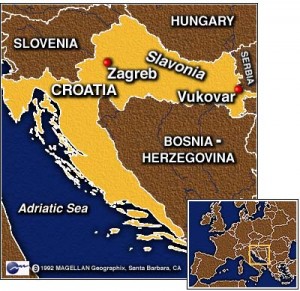 are still here and we are very very far from true reconciliation.” He went on to say that Christians in the Balkans are still struggling with truth and justice, and wonder whether grace can apply without the prior steps of truth and justice.
The Balkan countries still celebrate war criminals as heroes of the nation, often with the church’s approval. Rapes, tortures, concentration camps, ethnic cleansing—these memories of war still haunt the landscape. The translator asked, How can we “do grace” in such a setting? More, how can we keep another Balkan war from breaking out again in several decades?
I did write the preface, beginning with these paragraphs:
If I had originally envisioned this book for a Croatian audience, it would be a different book. How so? I cannot say for sure. The Balkans do not need an American writer to barge in with a limited understanding of your history and culture and offer advice.
For this reason I present this book as a kind of dialogue with you the reader. I depend on you, indeed I urge you, to take what I set forth in these pages and apply them to your own country. At times, as you read, you may find yourself shaking your head and saying, “He doesn’t understand Croatia!” You are right—I don’t. But you do, and it is up to Croatians to come to terms with your recent past as well as your distant past.
I went on to say that as an American I can offer some hope. After all, I grew up in the southern state of Georgia, which endured a brutal campaign by General William Tecumseh Sherman, whom some historians credit as introducing the modern “scorched earth” tactics of total war. His troops burned my home city of Atlanta to the ground, and all over Georgia you can find bronze markers recalling the destruction his armies inflicted during their March to the Sea.
 My Philadelphia uncles used to taunt me by asking me to book them a room in Atlanta’s “General Sherman Hotel,” which of course did not exist. We viewed Generals Sherman and Grant as war criminals, and in school we were even taught to scorn President Abraham Lincoln, who had forcibly reunited a divided country. The Georgia state flag incorporated the design of the Confederate flag, and I went to a high school named for a Confederate general. A popular bumper sticker in my childhood featured a cartoon figure of a Confederate soldier with the words, “Hell, no, we ain’t forgettin’!”
Before the Civil Rights Act forced change, we southerners also trampled on the rights of citizens from a different race. In a genteel version of ethnic cleansing, we fought in the courts and sometimes on the streets to keep them out of “our” restaurants, churches, neighborhoods, and schools. One race used to own the other, and I can hardly imagine a starker example of “Ungrace” than the slave trade that brought millions across an ocean to serve wealthy plantation owners. Visit the modern city of Atlanta today, however, and you will find few vestiges of that kind of racial division and regional patriotism. It takes time but wounds heal, justice triumphs, change happens.
Historian Shelby Foote points out that only after the Civil War did Americans start saying “The United States is…” rather than “The United States are….” Our identity as one nation came out of our  bloodiest war. Indeed, I recently learned that the burning of Atlanta played a crucial role in that re-union. Exhausted by war, the Democratic Party of 1864 adopted a platform calling for peace negotiations based on recognizing Confederate independence and nominated General George McClellan to oppose the beleaguered President Lincoln in that year’s election. News of Sherman’s September triumph in Atlanta helped swing popular support back to the Republican incumbent Lincoln, who pursued the war to its conclusion.
More recent times show that the same pattern of healed wounds can apply internationally as well. Two of America’s closest allies are Germany and Japan, the two nations who opposed us in the most destructive war in history. U. S. ties are strengthening with Vietnam, another nation who fought us in a bitter and bloody campaign. I have witnessed similar scenes of reconciliation in places like Germany, where East and West reunited, and in South Africa, where under the leadership of Nelson Mandela a majority race chose the way of truth but not revenge and in the process forfeited justice for the sake of reconciliation.
For these reasons, I have hope for Croatia and its neighbors. Fortunately, Croatia has outstanding scholars and pastors who are seeking how best to apply theology to their nation’s history. Among the most insightful is Miroslav Volf, who emigrated from Croatia to teach at Fuller Seminary in California and then at the Yale Divinity School. The End of Memory, a magnificent book, includes his comments about memories of the traumatic past: “They need not colonize the present nor invade the future by defining what we can do and become. Past wrongdoing suffered can be localized on the timeline of our life-story and stopped from spilling forward into the present and future to flood the whole of our life.”
Grace is the only force I know of that can block the toxic influence of a painful past on the present and the future. As Volf says, “For in the light of Christ’s self-sacrifice and resurrection, the future belongs to those who give themselves in love, not to those who nail others to a cross.”
For years the Balkans have been a laboratory of what I call “Ungrace,” the law in relationships that echoes one in physics: Every action causes an equal and opposite reaction. You have lived with the deadly consequences of that law for centuries. Can the modern Balkans become instead a laboratory of grace? And what would that look like?


Another thought provoking piece of writing and how refreshing to hear someone say “I don’t understand your country”. Bill Fleming’s comment made me think about how key this is. As a denizen of the country that historically caused all the problems in Northern Ireland and at times paid in blood for their interference I know all about lack of understanding. Both politicians and public in the UK have long ignored, or been ignorant of, our being the cause of the problems there and promoted shoot to kill policies as the way to deal with the IRA and the like. I thank to Lord ost days that he has provided us with men of faith and insight who were able to move beyond this.
Problems in the Balkans are, at least in part, the result of European “powers” attempting to redraw borders, and we can only pray God will bring men to the fore who show the grace needed to move past the very real hurts and begin to mend wounds.
I do not have a comment on the above essay but I do have a question for Mr Yancy. I am a physician and deal daily with a multiplicity of physical problems with my patients from very minor to very life threatening. I have read your comments on pain and what the bible has to say about pain, physical disease and Jesus’ healing and reaction to disease and suffering. I am frustrated and lost however when dealing with mental health issues. I feel that the bible especially does not deal with how to handle mental health issues such as OCD , severe depression and anxiety. Sure it tells us not to be discouraged and not to be anxious but the depth of disease that some people face is so much deeper than ordinary people like myself can fathom and in some ways is much more life altering and painful than physical problems such as cancer and heart disease.
Having grossly intruded the first time, I’ll attempt brevity, and then cease.
1. I hope I did not add salt to wounds for dezi and others (because I see the compromise and give in to it). I am sorry. 2. There’s an interview of a conscientious objector on a blog at Slate magazine (The Wrong Stuff) dated Dec. 16, 2010. He demonstrates an initial “Patriotic Christian” view, goes to war, and via Gandhi and the Golden Rule (Do unto others etc.), becomes a consc. objector. Thought dezi might like it.
That is all.
I really would like to thank Steph who elaborated her thoughts in her first comment and showed me a powerful testimony of a young Christian man at Slate Blog, ‘The Wrong Stuff’ dated Dec. 16, 2010 (Conscientious Objector, Josh Stieber). This is powerful because I can see that the Word of God has been active in this young gentleman’s heart all the way otherwise he wouldn’t have taken that risk. That was a fresh reminder of true hope in His Word.
I would also like to let you know that God is working in my heart. Until a few weeks ago, I had been struggling quite a lot in my church life and so had my American husband as well since both of us were aware of our own judgmental attitudes toward conservative Christians. But when God’s message was delivered powerfully through my husband’s preaching at one Sunday service (he’s one of our church’s ordained people) after his mind-wrestling with His Word and lots of prayers with tears, God spoke to him, me and possibly at least some of our congregation, I believe. To me so-called nine Spiritual Fruit (Gal 5: 22-23) quoted at the sermon at the time was something that got me back to the basic — God’s standard, not the world’s standards that I often tend to fall in. His standard is for my ideal integration following Jesus’s image.
With a sharp contrast of the nine Spiritual Fruit, a list of our sinful nature (Gal 5: 19-21) also turned out to be a good reference to convince me that things seemingly related to our warfare such as ‘hatred’, ‘discord’ , ‘fits of rage’, ‘selfish ambition’, ‘dissensions’, and ‘factions’ (NIV) are against His Will for us. Even if some people claim that ‘their missions’ in wars are totally different from what is written in Galatians 5:19-21, it doesn’t make sense to me especially when I see the whole world as His own creation as His beloved one community, rather than seeing a particular nation as the one He prefers. Where people accept killing civilians in wars as their “mission”, my question arises — would He want us to exterminate or totally change ‘different others’ because of the disagreement? I do not think so. I believe any kinds of positive change according to God’s will should begin in me/us, just like the one having occurred to that young American man, Josh Stieber, interviewed at Slate Blog. Changes staring in our own selves seem to be the key to ultimately and truly being open to God.
Personally I imagine that God might be pleased to have more and more people experiencing two or more different worlds, just as Steph does (I suppose), Josh Stieber does and myself (having been going through different church orientations-sort of). I don’t think ‘experiencing two or more worlds’ has to do with visibly different worlds, but with more internal things like different value systems and beliefs. Surrounded by them, we often struggle and cry for help to God. During the time, we might find some underlying backgrounds of different value systems and beliefs. Even if we experience our faith being shaken by the different values, His Word will get us back to His truth, His love, I believe. This kind of “getting-back” experience can be a genuine drive to spread the Gospel to the world, not by capitalism or democracy and never by the force, but by love, respect and humility. People dealing with different values would be given the channels to communicate with those with different values, which might turn out to contribute to desired peacemaking. I may be theologically wrong but I can’t help connect this people bridging different worlds with God’s Word in Ezekiel: “I looked for a man among them who would build up the wall and stand before me in the gap on behalf of the land so I would not have to destroy it” (Ezekiel 22:30 NIV).
Although I don’t know how much I’ve been able to communicate with you in my limited English, it’s been a big blessing for me to get this kind of urge to try understanding what it’s expressed and to try hard on opening up and ‘decoding’ my thoughts in English. God bless!
I love the idea of forfeiting “justice for the sake of reconciliation.” That’s what it’s all about. Great article/blog/whatever this is called.