

 Like the rest of the country, I’m reeling from news of the terrorist attack at the Boston Marathon and the follow-up spree of violence and subsequent manhunt. I keep flashing back to September 11, 2001, when I like most Americans sat glued to the television trying to absorb news that was unabsorbable. Now, almost twelve years later, the cloud of fear and apprehension has descended again on the United States.
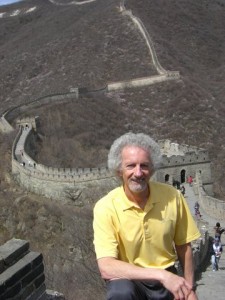
I was in China the day of the marathon, on the last leg of a trip that took my wife and me first to Malaysia, then to Beijing and Shanghai. Friends and family were concerned about our safety in view of saber-rattling in North Korea and reports of a new bird flu epidemic in China. Little did we know that the U. S. was the more vulnerable place.
It’s a different experience, hearing about tragedy from another country, especially one like China which tightly controls the news and blocks access to Facebook. The Chinese press understandably focused on the graduate student from China killed in the bomb blast. To most of the world, what happens in the U. S. seems very far away. Three people died watching a race—meanwhile 42 died in Iraq bombings, scores died in Syria, and yet another mine collapsed in China. To those of us Americans, however, it feels like a kick in the gut, wherever we are, and waves of helplessness and fear wash over.
Like a bipolar magnet, the United States attracts and repels with equal force. While I was traveling, the Gallup organization reported that 150 million people would like to move permanently to the U. S., triple the number who chose either of the next two countries on the list (the U. K. and Canada). Yet the U. S. also attracts hostility that sometimes boils over into acts of terrorism. Why do they hate us so?
I heard a British historian answer that question with a shrug. “You’re the top dog. Look at the history of conquest and colonialism. Romans, Germans, French, Dutch, Italians, Spanish, Portuguese, Mongols, Persians, Russians, British—they all took turns ruling large parts of the world, and they all inspired hatred. It goes with the territory, especially if you’re rich.” Others have a more sinister view: a majority of the world and a huge majority in the Middle East and Central Asia blame “US policies and actions in the world” for inciting terrorist attacks.
Traveling overseas, I had plenty of opportunity to think about the strengths and weaknesses of my country. It occurs to me that both trace back to our love of freedom, the transcendent value that inspired our founders to pledge their lives, their fortunes, and sacred honor.
Much of the world views freedom with suspicion, focusing on its dark side. As they see it, Americans have the freedom to own assault rifles that kill innocent children; to pollute the Internet, magazines, music, video games, and movies with pornography and violence; to allow greedy bankers to wreak economic havoc; to proselytize anyone of another religion; to divorce and abort at will, undermining family systems; to gobble up natural resources while billions live in squalor.
 A Muslim nation like Malaysia prefers control. Converting a Malay from Islam to Christianity is a serious crime. Movies are so strictly censored that on a Malaysia Airlines flight I watched a movie in which a statue of Cupid had its backside blurred out. “We are attracted to what we most fear,” said one thoughtful Muslim. “Imagine what decadent American culture represents to a young Muslim who, outside his family, has never seen a woman’s knee, or even her face.”
 As for China, it seems caught in a schizophrenic transition, with its women wearing the latest mini-skirted fashions and the bright lights and seductions of consumer capitalism out-dazzling anything in the West, even as the government clamps down on Google and Facebook and continues to persecute Christians and other religions in the hinterlands.
Salman Rushdie said the true battle of history is fought not between rich and poor, or socialist and capitalist, but between what he termed the epicure and the puritan. The pendulum of society swings back and forth between “Anything goes,” and “Oh, no you don’t!” Radical Islam swings one way; what its advocates see as the decadent West swings another. On a beach in Malaysia I saw female Saudi tourists in full burqa garb, covered in black except for eye slits, strolling next to bikini-clad European tourists.
As an American, I felt better about our recent fractious election when I read the government-controlled newspapers in the buildup to Malaysia’s coming election. The same party has held power since independence in 1956 and newspapers had at least 40 pages of bald propaganda about how great the party is with scant mocking mention of the opposition. In China I had to read between the lines to guess at the truth behind the bird-flu scare and the perils of pollution (1.2 million Chinese die prematurely each year from exposure to outdoor air pollution). I get tired of all the lawyer ads on U.S. television, but wouldn’t trade them for a country that has virtually no consumer rights. And unless you’ve spent time in a country where corruption is endemic, you can’t really appreciate our ability to get a driver’s license, get accepted in university, or start a business without paying a substantial bribe.

The world increasingly faces the challenge of how to govern a pluralistic society in which some members cling to traditional values and find other subcultures positively offensive. Not so long ago, most Islamic nations were championing the ideal of a secular state. Now, fundamentalists are on the rise, vigorously resisting cardinal values of the West such as human rights, democracy, sexual equality, capitalism, a scientific worldview, religious pluralism. Witness the murders committed against health workers who are vaccinating children against polio or against girls simply trying to get an education.
Meanwhile in the U.S., counter-cultural Christians face the challenge of living in a secular society which trumpets contrary values and is growing increasingly hostile to those who oppose them.
Freedom has always been a risky proposition. It astonishes me that God entrusted us with that gift, in view of our appalling abuse of freedom throughout history–beginning in Genesis, continuing to the present dark day, and including even the killing of God’s own Son.
The United States shines as a beacon to those who lack freedom, even as it represents a threat to those who fear it. A few decades ago, just as China was emerging from the tyranny of Maoism, someone asked a Chinese general, “What is your opinion of the French and American revolutions?” He thought for a moment on his own nation’s tumultuous history, spanning 7000 years, and replied, “Too early to tell.”
God, bless America. We need it at such a perilous time.


The Old Testament Attitude to Homosexuality
Gordon J Wenham *
Expository Times 102 (1991): 259-363.
[Reproduced by permission]
Back
* The College of St Paul and St Mary, Cheltenham
That the Old Testament condemns homosexual acts is well known. Why it does so is a mystery. Various suggestions have been put forward. Driver and Miles[1] for example held that it was a development parallel to that in Mesopotamian law. The older Laws of Hammurapi do not mention the offence, whereas the Middle Assyrian laws condemn it. They suggested that a similar development occurred in Hebrew law. The earlier laws do not discuss homosexuality, while the latest (P) texts demand the death sentence for it (Lev 18:22, 20:13). Similarly Coleman[2] tries to derive the biblical attitude from the attitude of other nations, specifically the Egyptians. Indeed he suggests there was a common Semitic consensus opposing homosexual practice.
Now it cannot be ruled out a priori that the Old Testament shared its neighbours’ attitudes to homosexuality. There does seem to have been a large measure of agreement in the ancient world as far as heterosexuality was concerned. Marriage law and
[p.360]
customs, for example, the repudiation of pre-marital intercourse and adultery, the acceptance of polygamy and divorce, seem to be much the same throughout all those Near Eastern cultures for which evidence is available.[3] The most obvious difference between Israel and its neighbours as far as heterosexual morality is concerned lies in the area of incest. Here the Old Testament rules,[4] forbidding union with consanguines and affines of the first and second-degree, go much farther than their neighbours, who sometimes even countenanced unions of consanguines of the first degree, e.g. brother and sister. So it could be that in repudiating homosexual practice the Old Testament is simply adopting the attitudes of surrounding nations.
However the evidence at present available suggests that this is not the case. The Old Testament rejection of all kinds of homosexual practice is apparently unique in the ancient world. Most of the ancient Near East adopted an attitude to ….. [excess content removed]
America was founded on the Godly ideals of freedom and equality as reflected in the Declaration of Independence: “We hold these truths to be self-evident, that all men are created equal, that they are endowed by their Creator with certain unalienable rights, that among these are life, liberty, and the pursuit of happiness.” Four score and seven years later, Abraham Lincoln famously revisited the theme. America’s founding fathers had, he said, “brought forth on this continent a new nation, conceived in liberty and dedicated to the proposition that all men are created equal.”
These ideals are, of course, good—but they are so easily twisted into something that isn’t good at all. Whilst the freedom that America seems to embody is in many ways tantalising, I respectfully suggest that it is a distorted version of the original. It isn’t the kind of freedom symbolised by the garden within which Adam and Eve were free to roam; that freedom was to be enjoyed in the context of God’s welcome company and providential care. Rather, it appears to be a counterfeit freedom focused on self as a substitute for God—a freedom represented by the forbidden fruit of which Adam and Eve took lustful bites to their (and our) harm.
The Bible teaches that real freedom is freedom from self to love God and neighbour, not freedom for self to the exclusion of God and neighbour. It seems to me that Life, Liberty and Happiness are not to be pursued as ends in themselves. No, God is to be the focal point of our pursuit—and life, liberty and happiness are to be received gratefully as by-products of that pursuit. America’s founding ideals have this wrong. Though they are derived from God, they effectively oust God in the name of a false, godlike Self whose chief end is Life, Liberty and Happiness. God is invited along for the ride—“God bless America!”—but only as the enabler of America’s quest for a fully actualized, even divine, Self.
One of the results of this elevated self-view is, frankly, arrogance on the international stage. There is much to like about America, but its deep-seated belief that it is, in President Obama’s words, “the last, best hope on earth,” probably isn’t among its most likeable characteristics. Too many Americans have a swagger about them. Americans are known the world over as “loud.” Hand-on-heart pride in one’s country is fine, but chest-thumping, condescending egotism is just plain unattractive—and ungodly. Maybe this super-confidence has something to do with why people who hate America do so with such conviction? I hasten to add, I’m not one of them.
I think God yearns to bless America, but is America willing to lay down its quest for an aggrandized Self, clothe itself in humility and start pursuing God as an end in himself? Life, liberty and happiness are abundantly available in God, the only true Source of freedom in the universe.
I have been trying for several days to write you in a way that would communicate the experience I am, once again, living through. This may not be appropriate for your comments here, no harm by not approving it.
I am just short of my 60th birthday and have not had a day without some amount of pain in at least 15 years. My spine, cervical to sacral, has decided to wage war against me living a normal life, I am now deciding on having my 5th and 6th surgeries, or stopping here. Each one helps for a bit, each one causes further damage. There are people worse than me, I am worse (pain wise, but not limited to pain!) than others.
I am a Christian, though that word has become harder for me to admit to, not because of fear of identification with Christ, but instead, with the religion.
I am reading your book on pain for about the 5th time. “Where is God When It Hurts?” has been a lifesaver, a warm comforter to curl up with, a friend to sit by me and encourage me since a pastor shared his battered copy with me 9 years ago.
Quite bluntly, I have to fight resentment and even hate feelings **gasp** frequently at the Christianity being promoted in our country. I love my country, I love the Lord, but I have to tell you I am about fed up with walking in churches with my walker (which I am so blessed to be able to run into a discount store and purchase and have mobility!) and being looked at as though it is a symbol of sin in my life, as happened as little as 2 weeks ago. The preacher stood there and said God wants to heal everyone and if He is not healing you it is because of something standing in the way, that in his experience, people who are not healed are grumblers and complainers who need to get over it so God will step in and heal. It was a long walk to the exit. I felt the weight of the eyes of judgement and speculation added to the weight of my body!
He also went on to proclaim that God wants everyone to be rich, prosperous and blessed financially so we can go out and bless others. He stated he is not a prosperity preacher, he is a truth preacher.
Why does every denomination and most preachers seem to think that they have the REAL understanding of the Bible? If you disagree with me, you disagree with God and His Word? It is not just my God that I want you to know, it is not just Jesus Christ, and Him crucified that I am sharing, it is my understanding and I understand everything and what I understand is the truth and if you don’t agree with me you don’t agree with God and His Word.
What is the response when this teaching goes to China, and Peru and all over the world as is the plan of this man (please understand, this is my latest encounter, not my only, with this teaching.) and his wife? Is this really the message we are to bring around the world? Are we really supposed to be preaching our culture and thoughts and values to people who have need of a Christ we can cling to even when (especially when) there is no healing and prosperity and relief of pain or even a drug store to walk in and buy a new set of wheels?
So now I can move on to another church, maybe the one with the split between the pastor and the assistant pastor..oh, now I have two choices..and the same split divided families because only sinners went with the pastor according to the asst. pastor, and only visa versa. Because, of course, each on had THE TRUTH. I could go on, I won’t.
I agree with you that we are NOT supposed to have all the answers. No one has all the truth. We live in a world full of broken and fallen pieces and the question is not as much “why”, as what will I do with it? Telling the world that their poverty and sickness and lack of wealth and healing is a sign of their sinfulness is a great way to spread hate, don’t you think?
Thank you, Mr. Yancey, for understanding and kindness in response to my comment. I have my “soapbox moments” and the writing gets messy, like life. I appreciate your kind apology, the pain (physical aside) in hearing this type of preaching cuts me deep inside, but not for myself as much as for what the church in this country seems to be, for the harm it is doing in the world, for the lies about who God really is; how vast and big and incomprehensible our God really is.
Here I am, Sunday morning, I have been awake since 4am. I want to go to church. I don’t want to go to church. I want to go, and worship God without demanding a healing, without reminding Him of the ways He is supposed to behave, without the preacher preaching their ideas and doctrine and theology and being so unaware that it is an icon . They tell me I want the perfect church, I don’t think so. I want to worship with people who know how BIG God is, how small we are. I want a church that introduces people to our living God, one that allows Him to do His work in us; one not afraid to say that sometimes life stinks, it hurts, I hurt, I don’t have the answers but here…here…is God. I want a church that does not try to define Him in 3 points, a church that does not attempt to diminish God to my understanding or elevate me to His level (I am a friend of God…repeat 22 times and call it a worship song), but one that points to Him, and, as C.S.Lewis writes of, encourages me to invite the great iconoclast to work in my live life.
For starters, this is what I want.
It is this God alone that will sustain us and give us joy when we live with poverty and abuse and abundance and everything in between the two and when our child dies and when our spouse experiences flashbacks of war, and when our daily life is pain. Ask me how I know. It is this God, the big one, the Creator and Redeemer I seek, and know that even then, my understanding is an icon!
OK, soapbox over, I step down! Thanks for being a pointer to Him, your writing is a hand to hold along the way.
Hi, Mr. Yancey. I’m one of the people who posted a comment on your past article, “International grace” on 2/16/11. I looked back my posting and realized that what I’m struggling with hasn’t changed. My church life here in America has never been easy since. But I have been to church on and off.
American Christian churches’ seemingly general ongoing mixture of worshipping the Lord and the sate/esp. military can make me feel like suffocating. Almost no church members and pastors seem to question about this and see this as idol-worshipping so that it is sinful. Even some of them would see a person like me as unbiblical and would like to expel a person like me. But still they blindly believe they ARE the Christians.
As I wrote in my last post, they seem to be always right.
Because they are right and ‘faithful Christians,’ God is always on their side.
I think this is one of the factors why the world hates America.
I was shocked at yesterday’s service, when I assume so many preachers in the U.S. preached that Christians should respect and honor men and women in the uniform. But what shocked me was more than that. Our pastor repeatedly said in his sermon that the soldiers fought and died for American Christians’ freedom, freedom to read the Bible, freedom to come to church and freedom to spread the Gospel. My jaws almost dropped off. Are all the soldiers Christians? Does/Did the U.S. government order the troops to fight for the Christians’ freedom? It was so disappointing to hear such preaching.
I understand that I should tolerate so many unpleasant, ‘ungrace’-kind of things to hear in this secular world. But what I struggle with is I have to hear something that doesn’t accord to what Jesus wants us to know, be and do from church leaders, relishing with Word of God or even in the name of God.
Somehow many people in this country (maybe in other countries, too) seem to believe in a religion called America. Just like other religions, this religion seems to bear ‘un-grace’ while Christianity reveals grace. Whether those who believe in this are Christians or not, they often seem blindfolded and they do not care about what the rest of the world sees them and still see themselves always righteous. Already being a top-dog, the U.S. may have some more reasons to be unfavored by rest of the world.