

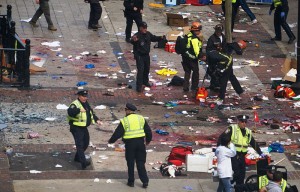
 Like the rest of the country, I’m reeling from news of the terrorist attack at the Boston Marathon and the follow-up spree of violence and subsequent manhunt. I keep flashing back to September 11, 2001, when I like most Americans sat glued to the television trying to absorb news that was unabsorbable. Now, almost twelve years later, the cloud of fear and apprehension has descended again on the United States.
I was in China the day of the marathon, on the last leg of a trip that took my wife and me first to Malaysia, then to Beijing and Shanghai. Friends and family were concerned about our safety in view of saber-rattling in North Korea and reports of a new bird flu epidemic in China. Little did we know that the U. S. was the more vulnerable place.
It’s a different experience, hearing about tragedy from another country, especially one like China which tightly controls the news and blocks access to Facebook. The Chinese press understandably focused on the graduate student from China killed in the bomb blast. To most of the world, what happens in the U. S. seems very far away. Three people died watching a race—meanwhile 42 died in Iraq bombings, scores died in Syria, and yet another mine collapsed in China. To those of us Americans, however, it feels like a kick in the gut, wherever we are, and waves of helplessness and fear wash over.
Like a bipolar magnet, the United States attracts and repels with equal force. While I was traveling, the Gallup organization reported that 150 million people would like to move permanently to the U. S., triple the number who chose either of the next two countries on the list (the U. K. and Canada). Yet the U. S. also attracts hostility that sometimes boils over into acts of terrorism. Why do they hate us so?
I heard a British historian answer that question with a shrug. “You’re the top dog. Look at the history of conquest and colonialism. Romans, Germans, French, Dutch, Italians, Spanish, Portuguese, Mongols, Persians, Russians, British—they all took turns ruling large parts of the world, and they all inspired hatred. It goes with the territory, especially if you’re rich.” Others have a more sinister view: a majority of the world and a huge majority in the Middle East and Central Asia blame “US policies and actions in the world” for inciting terrorist attacks.
Traveling overseas, I had plenty of opportunity to think about the strengths and weaknesses of my country. It occurs to me that both trace back to our love of freedom, the transcendent value that inspired our founders to pledge their lives, their fortunes, and sacred honor.
Much of the world views freedom with suspicion, focusing on its dark side. As they see it, Americans have the freedom to own assault rifles that kill innocent children; to pollute the Internet, magazines, music, video games, and movies with pornography and violence; to allow greedy bankers to wreak economic havoc; to proselytize anyone of another religion; to divorce and abort at will, undermining family systems; to gobble up natural resources while billions live in squalor.
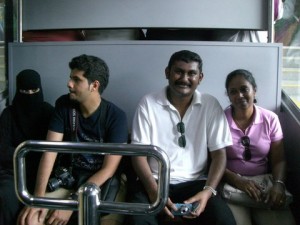 A Muslim nation like Malaysia prefers control. Converting a Malay from Islam to Christianity is a serious crime. Movies are so strictly censored that on a Malaysia Airlines flight I watched a movie in which a statue of Cupid had its backside blurred out. “We are attracted to what we most fear,” said one thoughtful Muslim. “Imagine what decadent American culture represents to a young Muslim who, outside his family, has never seen a woman’s knee, or even her face.”
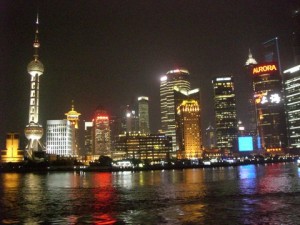 As for China, it seems caught in a schizophrenic transition, with its women wearing the latest mini-skirted fashions and the bright lights and seductions of consumer capitalism out-dazzling anything in the West, even as the government clamps down on Google and Facebook and continues to persecute Christians and other religions in the hinterlands.
Salman Rushdie said the true battle of history is fought not between rich and poor, or socialist and capitalist, but between what he termed the epicure and the puritan. The pendulum of society swings back and forth between “Anything goes,” and “Oh, no you don’t!” Radical Islam swings one way; what its advocates see as the decadent West swings another. On a beach in Malaysia I saw female Saudi tourists in full burqa garb, covered in black except for eye slits, strolling next to bikini-clad European tourists.
As an American, I felt better about our recent fractious election when I read the government-controlled newspapers in the buildup to Malaysia’s coming election. The same party has held power since independence in 1956 and newspapers had at least 40 pages of bald propaganda about how great the party is with scant mocking mention of the opposition. In China I had to read between the lines to guess at the truth behind the bird-flu scare and the perils of pollution (1.2 million Chinese die prematurely each year from exposure to outdoor air pollution). I get tired of all the lawyer ads on U.S. television, but wouldn’t trade them for a country that has virtually no consumer rights. And unless you’ve spent time in a country where corruption is endemic, you can’t really appreciate our ability to get a driver’s license, get accepted in university, or start a business without paying a substantial bribe.
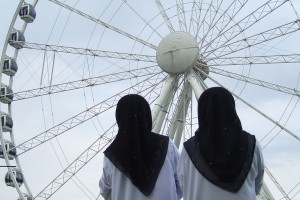
The world increasingly faces the challenge of how to govern a pluralistic society in which some members cling to traditional values and find other subcultures positively offensive. Not so long ago, most Islamic nations were championing the ideal of a secular state. Now, fundamentalists are on the rise, vigorously resisting cardinal values of the West such as human rights, democracy, sexual equality, capitalism, a scientific worldview, religious pluralism. Witness the murders committed against health workers who are vaccinating children against polio or against girls simply trying to get an education.
Meanwhile in the U.S., counter-cultural Christians face the challenge of living in a secular society which trumpets contrary values and is growing increasingly hostile to those who oppose them.
Freedom has always been a risky proposition. It astonishes me that God entrusted us with that gift, in view of our appalling abuse of freedom throughout history–beginning in Genesis, continuing to the present dark day, and including even the killing of God’s own Son.
The United States shines as a beacon to those who lack freedom, even as it represents a threat to those who fear it. A few decades ago, just as China was emerging from the tyranny of Maoism, someone asked a Chinese general, “What is your opinion of the French and American revolutions?” He thought for a moment on his own nation’s tumultuous history, spanning 7000 years, and replied, “Too early to tell.”
God, bless America. We need it at such a perilous time.


This resonated with me particularly as we lived overseas for a number of years and were overseas when 9/11 occurred. We had the same response from relatives – “aren’t you coming home?” My reply was, “The US is where this is happening. We’re as safe here as there.” And that is the new reality. There is no safe place on earth. Our only safety is in being where God wants us and leaving our lives in his hands.
Spent time living in Israel many years ago. Surrounded by Islamic states. Read the book “O, Jerusalem” in Jerusalem. Aware of the militant aggressiveness that led to many mistakes in dealing with their neighbors–BUT aware of the fundamental clash of cultures/ideologies there. Peace sure seems unlikely and that powder keg keeps the entire world on edge. Throw in the US support of Israel and the other issues Yancey mentioned and we will NEVER be secure from terrorist plots.
As an Indonesian who lives abroad, I somehow got the impression from other people of my country as a violent, dangerous, poor and sort of primitive, which is no wonder as the news hovering outside are only the negative ones, on how the radical Moslems terrorize our country with bombs, violence as well as open confrontations in public or media. Living as a Christian in the biggest Moslem country in the world is never easy, but again, since when is living as a minority ever easy? Regardless the fact that Indonesia acknowledges 5 officil religions, however the minority religion practicians never really stand too much a chance to enter politics, or even honest open debate on how we are wrongly discriminated in any aspect of life. However, regardless the increasing heat on religious and racial differences in Indonesia, we are still grateful for the opportunity to practice our belief, go to church regularly and celebrate Christian holidays. Currently living in abroad in a country with less religion strictness, somehow I am relieved, yet worried at the same time. Relieved that I see less “terrorism-related” bad news, yet worried of other aspect. Now I realize, what scare me the most is not the terror from other religious beliefs. I’m more terrified of the state of Godlessness that I see day to day. I’m horrified imagining the society and the culture that my children will have to live in, where people are rude, violent, selfish and Godless. Somehow, I suddenly miss Indonesia…
Hi Philip,
I’ve lived outside of the US for 12 years — in Japan, a strong US ally. At the same time, I’ve mingled with a lot of foreigners from English-speaking allies (Brits, Aussies, Kiwis, etc.). Possibly most important, I was overseas during most of the years G.W.Bush was president.
“Why do they hate us?” I would answer with a quote I heard somewhere, that “The US doesn’t have friends, it has interests.”
It may sound harsh and is probably difficult for us to recognize (let alone admit), but a lot of the world feels this very acutely. Even among allies.
Here in Japan there is the witness of Hiroshima & Nagasaki, as well as the loud presence of war machines in Okinawa that makes many on the island feel like the occupation never ended for them. Others remember the immense pressure Bush put on Primer Minister Koizumi after the 9/11 attacks to come to the US and pledge financial support, and later even military support that stretching the legal limits of Japan’s pacifist constitution — a document itself ironically drafted by the American occupation — and thus bolstering the Japanese rightwing nationalism that angers the rest of Asia.
The bottom line? It seems to be that for Japan, the principles that America helped Japan re-build upon were less important than getting support for America’s military interests under the Bush administration. And again, there is the ever-present shock and pain when we hear Americans defend the atomic bombing by saying, “It saved millions of American lives.”
America was built on great written principles, but the world sees that these are often set aside if it is in America’s interest. Supporting “friendly” dictators who oppress their own people. The covert wars of the CIA. Drone strikes. Economic sanctions and uneven trade agreements.
America’s own internal history bears the same witness. King spoke of how he wanted America to “cash the check” the forefathers had written but had never paid to black people. And perhaps more than any other people, Native Americans exist as living proof that we simply cannot allow the lofty speech of the founding fathers to get in the way of our own pursuit of life, our own liberty and our own happiness. (I wonder how many who have studied about the Trail of Tears are able to stand seeing Andrew Jackson’s face on the $20 bill?)
Since the beginning, as a nation we have had great ideas and great words, and sometimes as a nation we act on them… if it’s in our national interest. Our ideas versus our interests underline not only the injustices the nation was founded on (against Blacks and Native Americans), but the same disharmony also underlines the Revolutionary War: lofty words spoken about freedom and tyranny, but fundamentally the issue underneath was about money (high taxes). Even Jefferson would have left Christ’s “Give unto Caesar” teaching in his cut-up gospel, but for the sake of the national interest in money, he and the other founding fathers set aside Christ’s teaching and decided that high taxation was reason enough to take up arms and take lives (even British Christian lives).
Most of the world clearly sees the disharmony between our ideas and our actions… even while being seduced by our prosperity. And when they can’t see it, often they can feel it. Sometimes there is a rational understanding, and other times there is an irrational hatred. But even in the latter case, often it is borne out of pain — such as American drone strikes killing 176 children in Pakistan.
My hope and my prayer is that the church will remove the garment of the Old Glory from herself (because it is not righteous) and wear only the righteousness of Christ instead. I pray that the church can be an intercessory force, people standing in the gap to be peacemakers, identifying with the suffering, but also identifying with the guilty and repenting as Daniel did to God for his people’s idolatry. I take comfort in reading that the “two witnesses” of Revelation prophesy to the nations “clothed in sackcloth”– in the garments of repentance.
Bless you in His grace,
Ramone Romero
Osaka, Japan
Wonderfully written. However, misses a few small things. Such as, how American ‘freedoms’ have always come at others’ expense, beginning with native peoples from whom the continent was stolen, violently. Secondly, the continuing over-valuing of ‘American lives’ as against lesser humans. And you forgot to mention the 30 nobodies blown up in Mogadishu on the same day. Are ‘free’ people just worth more than the rest of humanity? That alone might serve to explain “why they hate us”.