

 Like the rest of the country, I’m reeling from news of the terrorist attack at the Boston Marathon and the follow-up spree of violence and subsequent manhunt. I keep flashing back to September 11, 2001, when I like most Americans sat glued to the television trying to absorb news that was unabsorbable. Now, almost twelve years later, the cloud of fear and apprehension has descended again on the United States.
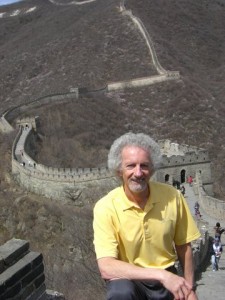
I was in China the day of the marathon, on the last leg of a trip that took my wife and me first to Malaysia, then to Beijing and Shanghai. Friends and family were concerned about our safety in view of saber-rattling in North Korea and reports of a new bird flu epidemic in China. Little did we know that the U. S. was the more vulnerable place.
It’s a different experience, hearing about tragedy from another country, especially one like China which tightly controls the news and blocks access to Facebook. The Chinese press understandably focused on the graduate student from China killed in the bomb blast. To most of the world, what happens in the U. S. seems very far away. Three people died watching a race—meanwhile 42 died in Iraq bombings, scores died in Syria, and yet another mine collapsed in China. To those of us Americans, however, it feels like a kick in the gut, wherever we are, and waves of helplessness and fear wash over.
Like a bipolar magnet, the United States attracts and repels with equal force. While I was traveling, the Gallup organization reported that 150 million people would like to move permanently to the U. S., triple the number who chose either of the next two countries on the list (the U. K. and Canada). Yet the U. S. also attracts hostility that sometimes boils over into acts of terrorism. Why do they hate us so?
I heard a British historian answer that question with a shrug. “You’re the top dog. Look at the history of conquest and colonialism. Romans, Germans, French, Dutch, Italians, Spanish, Portuguese, Mongols, Persians, Russians, British—they all took turns ruling large parts of the world, and they all inspired hatred. It goes with the territory, especially if you’re rich.” Others have a more sinister view: a majority of the world and a huge majority in the Middle East and Central Asia blame “US policies and actions in the world” for inciting terrorist attacks.
Traveling overseas, I had plenty of opportunity to think about the strengths and weaknesses of my country. It occurs to me that both trace back to our love of freedom, the transcendent value that inspired our founders to pledge their lives, their fortunes, and sacred honor.
Much of the world views freedom with suspicion, focusing on its dark side. As they see it, Americans have the freedom to own assault rifles that kill innocent children; to pollute the Internet, magazines, music, video games, and movies with pornography and violence; to allow greedy bankers to wreak economic havoc; to proselytize anyone of another religion; to divorce and abort at will, undermining family systems; to gobble up natural resources while billions live in squalor.
 A Muslim nation like Malaysia prefers control. Converting a Malay from Islam to Christianity is a serious crime. Movies are so strictly censored that on a Malaysia Airlines flight I watched a movie in which a statue of Cupid had its backside blurred out. “We are attracted to what we most fear,” said one thoughtful Muslim. “Imagine what decadent American culture represents to a young Muslim who, outside his family, has never seen a woman’s knee, or even her face.”
 As for China, it seems caught in a schizophrenic transition, with its women wearing the latest mini-skirted fashions and the bright lights and seductions of consumer capitalism out-dazzling anything in the West, even as the government clamps down on Google and Facebook and continues to persecute Christians and other religions in the hinterlands.
Salman Rushdie said the true battle of history is fought not between rich and poor, or socialist and capitalist, but between what he termed the epicure and the puritan. The pendulum of society swings back and forth between “Anything goes,” and “Oh, no you don’t!” Radical Islam swings one way; what its advocates see as the decadent West swings another. On a beach in Malaysia I saw female Saudi tourists in full burqa garb, covered in black except for eye slits, strolling next to bikini-clad European tourists.
As an American, I felt better about our recent fractious election when I read the government-controlled newspapers in the buildup to Malaysia’s coming election. The same party has held power since independence in 1956 and newspapers had at least 40 pages of bald propaganda about how great the party is with scant mocking mention of the opposition. In China I had to read between the lines to guess at the truth behind the bird-flu scare and the perils of pollution (1.2 million Chinese die prematurely each year from exposure to outdoor air pollution). I get tired of all the lawyer ads on U.S. television, but wouldn’t trade them for a country that has virtually no consumer rights. And unless you’ve spent time in a country where corruption is endemic, you can’t really appreciate our ability to get a driver’s license, get accepted in university, or start a business without paying a substantial bribe.

The world increasingly faces the challenge of how to govern a pluralistic society in which some members cling to traditional values and find other subcultures positively offensive. Not so long ago, most Islamic nations were championing the ideal of a secular state. Now, fundamentalists are on the rise, vigorously resisting cardinal values of the West such as human rights, democracy, sexual equality, capitalism, a scientific worldview, religious pluralism. Witness the murders committed against health workers who are vaccinating children against polio or against girls simply trying to get an education.
Meanwhile in the U.S., counter-cultural Christians face the challenge of living in a secular society which trumpets contrary values and is growing increasingly hostile to those who oppose them.
Freedom has always been a risky proposition. It astonishes me that God entrusted us with that gift, in view of our appalling abuse of freedom throughout history–beginning in Genesis, continuing to the present dark day, and including even the killing of God’s own Son.
The United States shines as a beacon to those who lack freedom, even as it represents a threat to those who fear it. A few decades ago, just as China was emerging from the tyranny of Maoism, someone asked a Chinese general, “What is your opinion of the French and American revolutions?” He thought for a moment on his own nation’s tumultuous history, spanning 7000 years, and replied, “Too early to tell.”
God, bless America. We need it at such a perilous time.


Amidst all of these tragedies, I keep remembering Jesus’ words about how ‘they will know you by your love’ and how rarely that happens, in terms of the news media.
They hate us because we do hateful things, all the while declaring our virtue.
Nice article Philip. Boy, big question. I must admit, I think the guy who said it’s because we’re the top dog is pretty close to accurate. Why does a teenager hate loving parents? Everyone who is miserable seeks to find someone to blame for his or her misery. The US is hardly perfect, but we are hardly to blame for all the worlds ills. I am continually incredulous at the level of irony in the writings of those who would blame America for being clumsy, self-interested, arrogant, judgmental, etc, as many have done in responding to your article. These people judge a time and place in American history (e.g. Philadelphia, circa 1789) far more harshly than they would blame Islamic terrorist for blowing up the world trade center. They fail to realize that their are many ways to read history. Sure you can say that America was built on the backs of slave labor and that our forefathers failed when they did not set the slaves free when they wrote the Constitution, and perhaps you would be correct. But you can also say that our forefathers, through the founding of this nation based on the principles of freedom, laid the foundation for the ultimate freeing of the slaves, women’s suffrage, and an unprecedented level of prosperity that has extended to a significant portion of the world. And you can judge Truman for dropping the bomb on Hiroshima. But it wasn’t your son or husband or brother who was going to die trying to invade the Japanese homeland. My goal here is not to justify anyone; I certainly am not trying to defend slavery! I guess what I’m saying is, judge not, let you be judged! Jesus didn’t say it’s okay to judge the rich and powerful, just make sure you don’t judge the poor and weak. He said, don’t judge. I’m not sure the important question is why they hate us. We should always seek to improve as a people and a country regardless of why they hate us. However, I’m not sure that we should be guided by the question of why they hate us to determine how we should improve. A parent should always seek to be the best parent possible and yes we can look at our kids to a certain degree to get a gauge on how we’re doing, but we might be great parents and still have kids that hate us. They hate us because Christ is not yet all, in all and their is still evil in the world. And as long as that is the case, there will always be hatred in the world. Yes we have much to improve upon as a nation, but the hatred of other nations and peoples is hardly a barometer for determining how we’re doing. Christ was perfect and yet he was hated. The best thing we can do is not hate them back.
Excellent read, loved the post. As usual, you stretch the mind and educate. While we must take responsibility for our flaws and how they affect the world around us, the best answer I’ve heard as to why Radical Islam hates us came from Bin Laden himself;
“We love death. The US loves life. That is the difference between us two.”
This is an excellent blog with a fine analysis of a multivariate problem. Looking at this as an American who has lived in Ecuador for more than a decade, I can say that on an individual level the U.S. is quite popular as a place most Latins would like to visit or live. Many have relatives who live in the U.S. and look on America with a smile.
However, on a political level the U.S. is quite unpopular in Latin America. There are many reasons for this (e.g., trade imbalances, U.S. military presence, or pollution from American companies’ irresponsible oil drilling practices, to name but three) but there is also the politically useful truth that there is nothing that can unite a fractured society or group of countries like a common enemy.
Americans used to roll their eyes at Hugo Chávez, for example, when he tried to blame the U.S. for the earthquake in Haiti in 2010 and accused the U.S. of wanting to invade and militarily occupy Haiti, or when he hinted in 2011 that the U.S. gives cancer to South American leaders (like himself), or even that first capitalism, then imperialism, had arrived and dried up water on the planet Mars, but those comments (and others) were intended to be politically useful.
In a less ridiculous fashion (but with great Latin fervor), Ecuador’s president Rafael Correa has referred to the U.S. as Imperialist Yankees and has repeatedly taken the opportunity to criticize the U.S. to the press. From a political standpoint, such South American leaders find the U.S. government to be a very convenient scapegoat, for again, a common enemy to blame for one’s ills is an effective political tool for uniting people.
Historically, it strikes me that every country around the globe, both now and down throughout history, has always had the goal of working towards self-interest. That is simply human nature. So if that means that one nation takes advantage of another, so be it. If the tables of fortune were turned, and the underdog became the top dog, the new top dog would take advantage of the old one. That’s how things go.
Thus the British historian quoted is quite right that the top dog is always hated – it goes with the territory.
When the top dog is knocked off by another, the new top dog becomes the target of envy and hatred. After all, do old former top dogs like Rome, Egypt, Greece or the Ottomans still inspire the same hatred and envy today that they must have inspired when in their prime so many moons ago? Look at what happened a half millennia ago in what is now Mexico: the Aztecs were widely hated by their subjugated neighbors, but when the Spanish conquistadors destroyed the Aztec empire (with the help of many who were only too happy to dethrone the Aztecs), the conquistadors became the new bad guys.
When the day comes that the U.S. is no longer the top dog or perhaps not even in the top group (and it will happen, if history is any guide to the fate of nations), I suspect that politically the U.S. will cease to be such a political whipping boy in many countries.
BTW, I enjoyed not just the fine article but reading the informed comments by others living abroad in response to it…